
Key Takeaways
- 01
Understanding what is a PMO ensures that projects align with goals. - 02
PMO types vary: Supportive, Controlling, and Directive structures exist. - 03
Key benefits include standardization, efficiency, mentorship, and cost reduction. - 04
AI-powered PMO tools automate tasks, optimize resources, and improve decisions. - 05
Future PMOs blend AI insights with strategy for competitive advantage.
Modern PMO software helps organizations standardize project governance, automate reporting, improve resource planning, and keep projects aligned with business goals. As AI capabilities continue to evolve, PMO software is becoming an essential tool for managing complex project portfolios. A Project Management Office or PMO is established in order to beat these difficulties and provide structure, focus, and management on projects. This poses a major question: what is a PMO?
Well, nowadays, PMOs are not merely administrative functions any longer. They help the teams to simplify the processes, improve collaboration, and establish the sense of clarity in complex projects. As technology and AI progress, PMOs are becoming more intelligent and more proactive. This guide will provide insights into the ways artificial intelligence-based PMOs are changing how projects are delivered and defining success in the modern organizations. So, let’s begin!
Ready to modernize your PMO with AI-powered project management? Schedule a demo to see how ChatPM Pro helps teams automate workflows, improve visibility, and deliver projects faster.
What is PMO Software? Understanding the Project Management Office
PMO software is a digital solution that supports the Project Management Office (PMO) by centralizing project planning, governance, reporting, resource management, and performance tracking. A Project Management Office (PMO) establishes standardized processes and ensures projects align with organizational goals, while PMO software helps teams execute these responsibilities more efficiently.
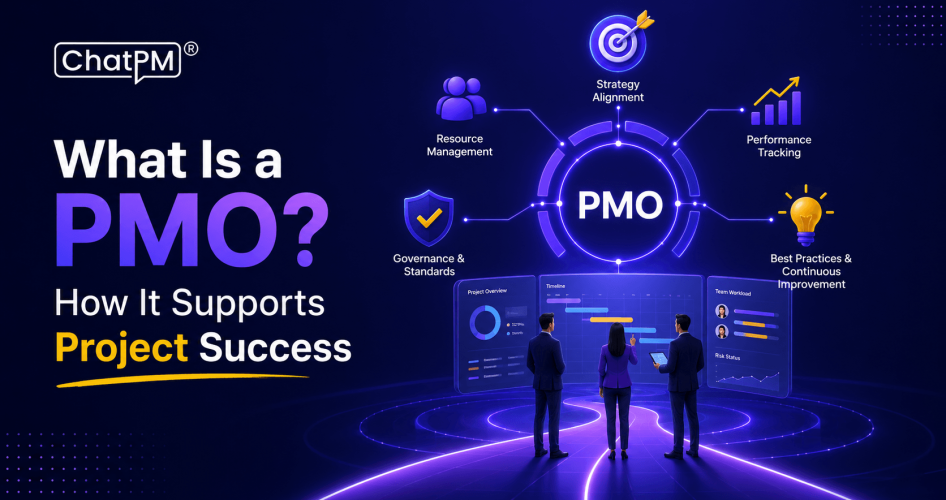
A PMO leads teams through difficulties, resource management, and quality control. It establishes orderly project processes and guides all initiatives by making sure that all projects are aligned to the strategic goals of the organization and its overall success.
Key Aspects of PMO
1. Creating standardized methods, templates, and best practices
2. Monitoring KPIs for scope, schedule, budget, quality
3. Managing resources efficiently across multiple projects simultaneously
4. Identifying risks, mitigating issues, ensuring compliance standards
5. Aligning projects with organizational goals and strategy
6. Providing mentorship, training, and support to project managers
Types of PMO Software and Project Management Offices
To understand PMO software, it’s important to first understand how different Project Management Office structures operate. PMO software supports Supportive, Controlling, and Directive PMOs by providing the tools needed to manage governance, reporting, collaboration, and project oversight.
1. Supportive PMO
A Supportive PMO provides templates, guidance, and training to help teams manage projects effectively. It works best where project managers are experienced and can handle projects independently.
2. Controlling PMO
A Controlling PMO enforces standards, templates, and processes to ensure consistency across projects. It gives senior management visibility while balancing support with oversight.
3. Directive PMO
A Directive PMO directly manages projects and allocates resources to meet organizational goals. Project managers report to the PMO, ensuring strong alignment and strict governance.
Key Benefits of PMO Software for Project Success
PMO software provides organizations with centralized visibility, standardized workflows, automated reporting, and better project governance. These capabilities help improve consistency, collaboration, and project success across teams.
1. Standardizes processes and improves coordination across all projects
2. Ensures consistency in reporting, planning, and resource use
3. Reduces project costs through better monitoring and control
4. Helps complete projects efficiently with structured guidance
5. Aligns projects with organizational goals and strategy
6. Centralizes project data for transparency and easy access
7. Provides mentorship, coaching, and training for managers
8. Improves quality by identifying areas for performance improvement
The Rise of AI-Powered PMO Software
AI-powered PMO software is transforming how organizations manage projects by automating repetitive tasks, providing predictive insights, and improving strategic decision-making. Businesses are increasingly adopting intelligent PMO solutions to improve efficiency and project outcomes.
AI agents and tools are now automating routine PMO tasks like data collection, reporting, risk identification, and resource allocation. By handling repetitive work, AI allows project managers to focus on strategic planning, problem-solving, and ensuring projects stay aligned with business goals.
An AI-powered PMO has the potential to transform project delivery by connecting data, streamlining workflows, and providing real-time insights. This shift can make PMOs more proactive, reduce errors, and help organizations achieve consistent project success using modernAI PMO tools.
How Can AI Transform PMO Software Operations?
Let us highlight how AI is transforming PMO operations in today’s organizations. The impact is significant, offering new ways to approach project management and decision-making that weren’t possible before.
Modern PMO software uses AI to automate workflows, optimize resources, predict risks, and provide real-time dashboards, allowing project managers to focus on strategic initiatives rather than manual administration.
1. AI-Powered Decision Insights
AI analyzes project data to spot trends and guide decisions. PMOs can optimize resources and act proactively.
2. Predictive Risk Management
AI forecasts potential risks and issues early in projects. This helps PMOs plan and prevent delays or overspending.
3. Smart Resource Allocation
AI predicts resource needs and assigns them efficiently. Teams experience less downtime and smoother operations.
4. Task Automation
AI automates repetitive work like updates and document handling. Project managers focus on strategic priorities instead.
5. Streamlined Collaboration
AI improves team alignment with smart recommendations and summaries. Communication becomes faster and more organized.
6. Automated Reporting
AI generates tailored reports for stakeholders automatically. Everyone stays informed with minimal manual effort using modern AI-powered PMO software.
Key Challenges to Watch for:
1. Skill gaps may limit effective use of AI tools.
2. Resistance to change can slow AI adoption process.
3. Poor system integration disrupts workflows and project efficiency.
4. Ensuring data privacy and security is critical.
5. AI bias may affect fairness and decision-making outcomes.
AI Technologies Powering Modern PMO Software
Let us understand the types of AI technologies that can help organizations choose the right tools to improve efficiency, accuracy, and overall project performance.
1. Generative AI: AI can capture lessons learned, create reports, and generate project content efficiently.
2. AI-Enabled Resource Management: AI optimizes allocation, forecasts demand and identifies skills gaps in teams.
3. Predictive Analytics: AI analyzes historical data to predict risks, delays, and budget issues.
4. Agentic Automation: AI bots automate routine tasks like reports, compliance checks, and risk assessments.
5. AI-Driven Governance: Automated audit trails enhance transparency and ensure compliance across projects.
6. Natural Language Processing (NLP): AI extracts insights from communications, summarizing actions, and detecting project risks.
The Future of AI-Powered PMOs at a Glance:
1. Enhance PMO capabilities without replacing humans
2. Enable smarter, data-driven project decisions
3. Improve efficiency and aligned project delivery
4. Make PMOs more strategic and impactful
5. Adoption of AI is essential for competitiveness
Embracing AI: The Future of PMO Software Excellence
Understanding what is a PMO can enable organizations to know how projects can remain on track, efficient, and strategic. PMOs are also being transformed using AI-powered tools to automate their functions, enhance decision-making, and offer real-time insights. The adoption of AI will guarantee improved management of resources, reduction of risks, and successful completion of the project in all initiatives.
ChatPM is an AI-powered PMO software solution that helps project teams automate reporting, track project performance, manage resources, identify risks early, and improve collaboration. It enables organizations to streamline PMO operations while delivering projects more efficiently.ChatPM assists PMOs to be efficient, make decisions, and deliver projects at a cost of saving time and effort by integrating intelligent and automation features.
With ChatPM AI agent, automate tasks, get real-time insights, and streamline project management.
Schedule Your Demo