Key Takeaways
- 01
AI agents shift PMOs from reporting to decision support. As a result, teams can focus more on strategic decisions. - 02
Predictive insights replace delayed, retrospective project reporting. Therefore, teams can identify potential issues earlier. - 03
Automated data collection improves reporting accuracy and consistency. In addition, it reduces the effort required for manual updates. - 04
PMO roles are evolving toward governance and strategic oversight. Consequently, teams can spend less time preparing reports. - 05
Successful adoption starts with strong data and focused pilots. This approach allows organizations to test AI before expanding its use.
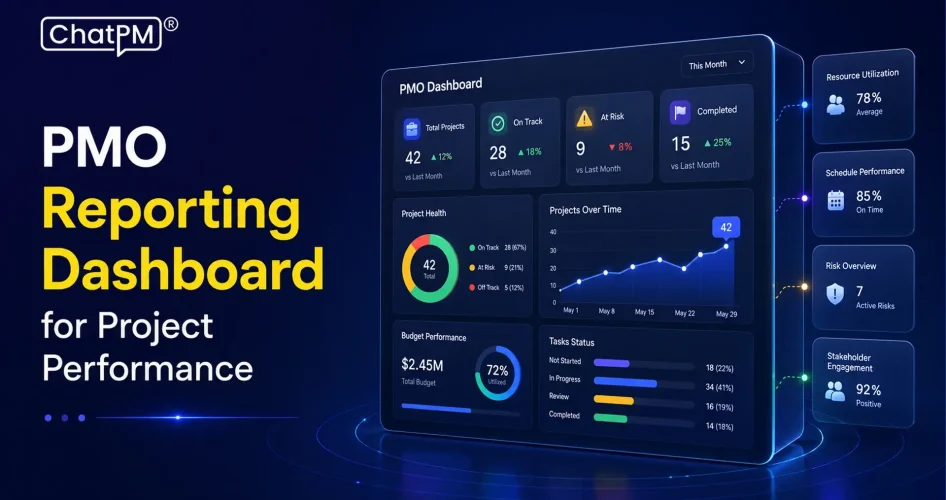
Project leaders have relied on PMO Reporting for years to track progress, measure performance, and keep stakeholders informed. Today, AI agents are changing how reporting works. Instead of waiting for updates, teams can access project insights, risk alerts, and status summaries in real time. As a result, this shift is reducing manual effort and changing the role of reporting across project environments.
If you are wondering what this means for PMOs and project leaders, then you are in the right place. The rise of AI agents does not eliminate the need for governance or oversight. Instead, it changes how information is collected, analyzed, and shared. In this blog, we will explore how AI agents are transforming reporting practices, the impact on PMOs, and the steps organizations should take to stay prepared.
Ready to modernize your PMO reporting with AI? Book a demo and discover how ChatPM Pro helps teams streamline reporting and make faster, data-driven decisions.
Why is Traditional PMO Reporting Software No Longer Enough?
Traditional reporting methods were designed for a time when project data changed at a slower pace. Today, organizations need faster visibility into risks, performance, and business impact. Therefore, Project Management Office Reporting has become a critical area for transformation.
Leaders no longer want reports that only explain past performance. Instead, they need real-time insights that support better decisions and improve responsiveness. In addition, these insights can connect project execution directly to strategic business goals through effective PMO Analytics.
1. Strategic Misalignment
Projects can meet deadlines and budgets while still failing to create business value. However, traditional reports often focus on delivery metrics. As a result, they can overlook whether the initiative supports organizational goals and expected outcomes.
2. Delayed Decision-Making
Most reporting frameworks explain what has already happened within a project. However, executives now need forward-looking insights. These insights can help them anticipate risks, identify opportunities, and understand likely future outcomes.
3. Disconnected Information
Manual data collection creates delays between project activity and stakeholder visibility. As a result, decision-makers often review information that is no longer current or actionable. Therefore, faster access to project information is becoming increasingly important.
4. Inflexible Reporting Models
Traditional reporting structures are built around fixed plans and stable priorities. However, modern organizations often need to respond quickly to changing business needs. Therefore, reporting systems must also adapt to changing project conditions.
5. Manual Data Consolidation
Many reporting processes still rely on spreadsheets, status meetings, and manual updates. As project complexity grows, these methods become difficult to scale. Consequently, they can increase the risk of delays, errors, and inconsistencies.
How Are AI Agents Transforming PMO Reporting Software?
AI agents are changing how project information is collected, analyzed, and shared across organizations. Instead of relying on manual updates and periodic reviews, they provide continuous visibility into project performance. As a result, teams can move beyond traditional PMO Status Reporting and make faster, data-driven decisions.
Key Ways AI Agents Are Transforming PMO Reporting Software
1. Predictive Forecasting
Traditional reports identify issues after they have already occurred. In contrast, AI agents analyze project trends and performance data to forecast risks before they impact delivery. Therefore, teams can take action earlier.
2. Automated Data Consolidation
Project data often exists across multiple tools and departments. AI agents automatically collect and unify this information. As a result, teams can create a more consistent and reliable reporting environment.
3. On-Demand Governance
Stakeholders no longer need to wait for scheduled reporting cycles. Instead, AI agents provide instant, context-aware responses to project questions whenever information is needed. This allows teams to access relevant information more quickly.
4. Continuous Budget Monitoring
Financial tracking becomes an ongoing process rather than a periodic review. AI agents monitor spending patterns, identify anomalies, and project future budget performance in real time. Consequently, managers can respond to financial changes earlier.
5. Automated Risk and Compliance Checks
Governance activities can be performed continuously instead of manually. AI agents review project data against policies, standards, and compliance requirements. As a result, teams can identify potential concerns earlier and respond more efficiently.
6. Autonomous Issue Resolution
Modern AI systems can do more than report problems. They can recommend actions, prepare supporting documentation, and initiate workflows to address project challenges. Therefore, teams can move from identifying issues to taking action more quickly.
7. Evolving PMO Responsibilities
The PMO’s role is moving away from collecting and validating data. Instead, teams can focus more on governance, strategic planning, and decision support activities. This shift allows PMO professionals to spend more time on higher-value responsibilities.
8. Outcome-Focused Management
Traditional reporting emphasizes schedules, milestones, and task completion. However, AI-driven environments place greater attention on business outcomes, value creation, and strategic objectives. As a result, reporting can provide a broader view of project performance.
Preparing Your PMO for AI-Driven Reporting Software
1. Build a Strong Data Foundation
Consolidate project data into one reliable source of truth.
In addition, standardize statuses, timelines, and reporting fields across teams.
Finally, establish governance rules for secure AI data access.
2. Prepare Teams for Change
Train teams on AI tools, prompts, and validation.
At the same time, shift PMs from report creation to strategic oversight.
In addition, develop skills for reviewing and refining AI outputs.
3. Choose the Right Tools
Adopt tools that automate repetitive reporting activities.
Furthermore, use predictive analytics to identify risks before escalation.
Most importantly, prioritize solutions that address immediate reporting challenges.
4. Start Small and Scale
Start by piloting AI within one reporting process or department.
Then, track efficiency gains and reporting accuracy improvements.
Finally, refine workflows before expanding AI across the organization.
Ready to Transform Your PMO Reporting Strategy With AI?
Traditional PMO reporting was built to document project progress, but modern organizations need systems that support faster decisions and better business outcomes. As AI agents automate reporting, forecasting, and governance activities, PMOs can shift their focus from administrative work to strategic leadership and value creation.
The organizations that benefit most from this change will be those that combine strong governance with intelligent automation. For example, predictive insights, real-time visibility, and streamlined reporting can improve how project performance is managed. In addition, solutions like ChatPM bring AI-powered collaboration, reporting, and project oversight into a single platform. As a result, teams can spend less time managing updates and more time driving successful project outcomes.