Key Takeaways
- 01
Identifying risks early protects project timelines, budgets, and overall delivery outcomes effectively. - 02
Mitigation, acceptance, avoidance, and transference are the four core risk management strategies. - 03
Tools like risk registers, SWOT analysis, and probability matrices help teams prioritize threats. - 04
AI and predictive analytics allow teams to detect and address risks before they escalate. - 05
Proactive risk mitigation transforms uncertainty into manageable challenges for stronger project outcomes.
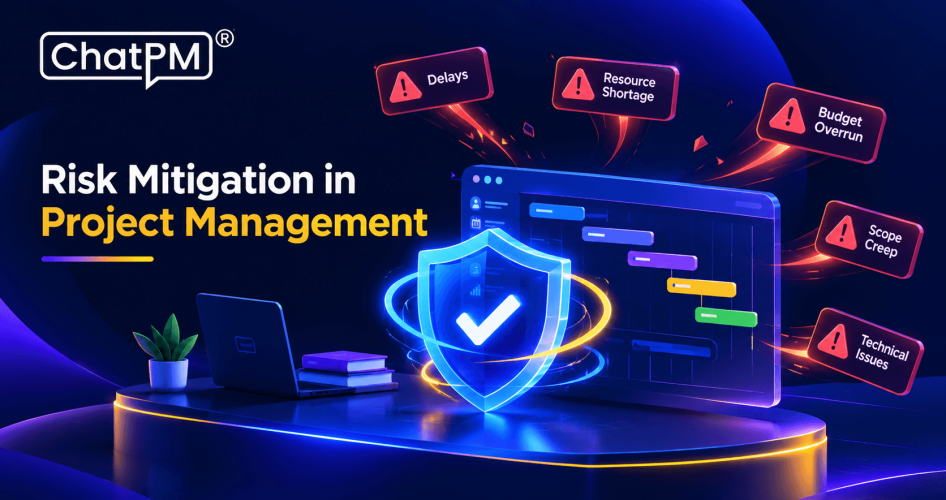
Projects rarely fail by chance. Instead, they often struggle when uncertainty is ignored or addressed too late. Effective risk mitigation helps teams identify potential threats early, assess their impact, and respond with clarity.
By preparing for uncertainty, organizations can protect timelines, budgets, and overall project outcomes. In addition, proactive planning gives teams greater confidence when unexpected challenges arise.
In complex business environments, risk management in project management enables informed decisions and steady execution. It connects strategy, people, and processes to reduce surprises and improve accountability.
In this blog, we explore practical strategies, essential tools, and the role of AI in managing project risks effectively.
Looking for smoother project execution without extra operational stress? At ChatPM, our simple project management service keeps everything organized and on track.
Understanding Project Risk Mitigation Tools and Strategies
Understanding risk mitigation in project management begins with recognizing uncertainty before it disrupts progress. It involves identifying possible threats, assessing their likelihood and impact, and preparing actions to reduce their effect.
As a result, this proactive approach helps teams safeguard schedules, budgets, and performance while keeping projects aligned with their intended objectives.
Risk mitigation is not a one-size-fits-all practice. Larger projects often require detailed planning and layered responses to manage complexity, while smaller initiatives may rely on prioritized risk lists.
However, the goal remains the same: address potential risks early so they do not escalate into issues that affect delivery.
Key Project Risk Mitigation Strategies
Effective risk mitigation relies on clear, actionable strategies that anticipate potential challenges and reduce their impact. By applying the right approaches, project teams can stay ahead of issues and maintain control over timelines and budgets.
Furthermore, these strategies help teams create a more consistent approach to managing uncertainty and achieving successful project outcomes.
1. Reduction (Mitigation)
This strategy involves taking proactive steps to lower the likelihood or impact of a risk. For example, teams can run pilot projects, test smaller changes, or strengthen existing processes to minimize potential problems.
As a result, teams can identify weaknesses earlier and reduce the effect of risks before they become larger issues.
2. Acceptance
Some risks are acknowledged but not actively prevented. This approach is suitable for low-impact risks and is often paired with a contingency plan or reserved budget.
Therefore, teams can continue with their planned approach while remaining prepared to manage potential consequences.
3. Avoidance
Risk mitigation can also mean completely eliminating a threat by adjusting the project plan, scope, or approach. This might include choosing a more reliable vendor, changing technology, or skipping a high-risk project phase.
In this way, teams can remove a significant source of uncertainty before it affects project delivery.
4. Transference (Transfer)
Here, the responsibility and impact of a risk are shifted to a third party. Common methods include purchasing insurance, outsourcing high-risk tasks, or using fixed-price contracts to protect the project.
Consequently, the project team can reduce its direct exposure while still maintaining appropriate oversight.
Wondering why risk planning should start on day one? Explore our in-depth guide on why risk management in project management is essential and how it strengthens decision-making at every stage.
Essential Project Risk Mitigation Tools
Effective risk mitigation relies on the right risk management tools to identify, monitor, and manage risks. These tools help teams act proactively, stay organized, and keep projects on track.
Moreover, using the right combination of tools makes it easier to prioritize threats and coordinate mitigation activities across the project team.
1. AI and Predictive Analytics
Advanced machine learning models analyze historical project data to forecast potential risks before they occur. These tools support proactive decision-making and strengthen risk mitigation by allowing teams to plan ahead.
As a result, project managers can respond to warning signs earlier and reduce the potential impact of emerging risks.
2. Risk Register (Central Repository)
A risk register serves as a central place to document, analyze, and track all identified risks. It ensures clarity in ownership, accountability, and action planning throughout the project lifecycle.
In addition, keeping this information in one place makes it easier for project teams to review risks and monitor their status.
3. Probability and Impact Matrix
This visual tool categorizes risks based on their likelihood and severity, helping teams prioritize threats effectively. It is essential for risk identification in project management and for focusing attention on high-impact risks.
Therefore, teams can direct their time and resources toward risks that require the most immediate attention.
4. Root Cause Analysis (RCA)
RCA digs deeper into the underlying causes of risks rather than simply addressing surface issues. By understanding root causes, teams can implement targeted mitigation strategies to prevent recurrence.
As a result, teams can address the source of a problem instead of repeatedly dealing with the same consequences.
5. SWOT Analysis
Evaluating Strengths, Weaknesses, Opportunities, and Threats allows teams to uncover areas of vulnerability. It also provides a structured approach for risk assessment and early action planning.
Furthermore, SWOT analysis can help teams recognize opportunities while preparing for potential threats.
6. Vulnerability Scanners / Stress Testing
These tools are critical for IT and cybersecurity projects because they help detect system weaknesses. Regular testing ensures resilience and reduces the chance of unexpected failures during operations.
In turn, regular testing gives teams a clearer understanding of system vulnerabilities and the actions needed to address them.
Not sure which project risks could impact your results most? Read our blog on common project risks and Smart Strategies to Prevent Them for practical prevention tips.
ChatPM: AI-Powered Project Risk Mitigation Tool
ChatPM is an AI-powered assistant that helps teams identify, monitor, and manage risks in real time. It provides insights and recommendations to strengthen risk mitigation and keep projects on track.
Additionally, its centralized approach helps teams maintain visibility across different areas of project risk management.
1. Predictive Risk Detection
ChatPM continuously monitors project data to detect potential risks such as budget overruns, resource bottlenecks, or deadline delays early.
This proactive approach strengthens risk mitigation by allowing teams to address threats before they escalate. As a result, managers can respond to potential issues with greater awareness.
2. Mitigation Strategy Generation
Beyond identifying risks, ChatPM uses AI to suggest actionable strategies tailored to each threat. By recommending preventive and corrective measures, it helps project teams implement effective risk mitigation practices quickly.
Therefore, teams can move from identifying a risk to planning an appropriate response more efficiently.
3. Real-Time Risk Dashboards
With Power BI integration, ChatPM provides visual dashboards that display risk levels, ongoing issues, and overall project health.
These dashboards enhance decision-making and make project risk management tools more actionable for managers. In addition, visual reporting makes important risk information easier to review.
4. Automated Monitoring
ChatPM continuously evaluates risk triggers and sends timely alerts when potential problems arise. This reduces manual oversight and ensures that risks are addressed promptly.
As a result, teams can maintain strong risk mitigation practices without relying entirely on manual monitoring.
5. ChatPM-GPT Insights
Users can interact in natural language to analyze data, identify trends, and evaluate potential threats. These AI-driven insights support AI-driven risk management by turning complex project information into practical guidance for risk control.
Furthermore, this approach allows project teams to explore project information and understand potential risks more clearly.
6. Centralized Data and Scalability
Acting as a single source of truth, ChatPM integrates with platforms like MS Teams and Azure to keep information secure and accessible.
It also scales with projects of different sizes. Therefore, teams can maintain visibility and proactive risk mitigation as project complexity grows.
Ready to Strengthen Project Risk Management with Risk Mitigation Tools?
Effective risk mitigation is essential for keeping projects on track, safeguarding budgets, and ensuring timely delivery. By identifying threats early, prioritizing risks, and applying strategic measures, organizations can transform uncertainty into manageable challenges.
In addition, these practices can help teams build stronger and more resilient project outcomes while improving their ability to respond to change.
ChatPM acts as an AI-powered assistant that centralizes project data, predicts potential risks, and suggests actionable strategies. By integrating with existing tools and providing real-time insights, it empowers teams to act proactively and improve decision-making.
As a result, teams can achieve more consistent risk mitigation across projects of different sizes and complexities.
Get started with ChatPM today!