Key Takeaways
- 01
Agentic AI helps project teams move beyond fixed automation toward adaptive and intelligent project workflows. - 02
Intelligent systems can monitor projects, identify risks, and support timely decisions with relevant project context. - 03
Agentic AI can reduce administrative work by supporting planning, reporting, task tracking, and meeting follow ups. - 04
Connected workflows help organizations improve resource allocation, project visibility, communication, and overall execution. - 05
Human oversight remains important for maintaining control over critical decisions, permissions, and enterprise project operations.
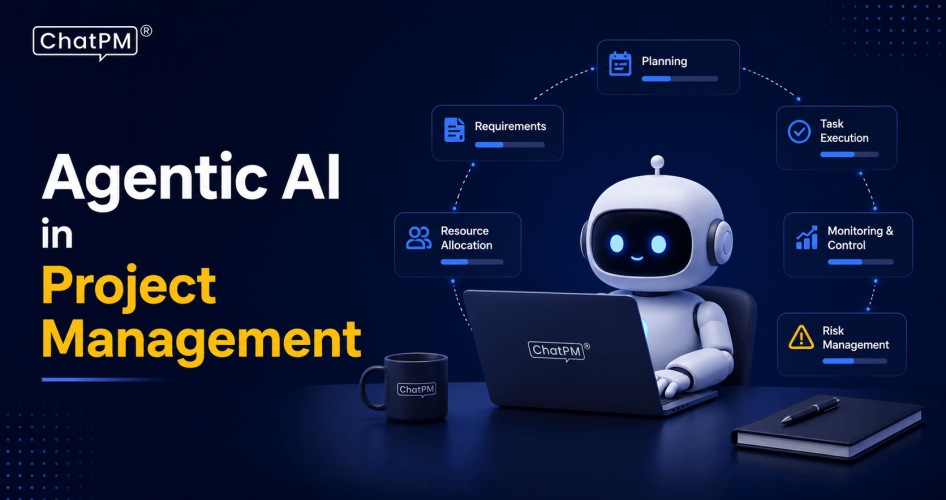
Traditional project automation helps teams handle repetitive tasks, but it often depends on fixed rules and predefined workflows. Agentic AI Project Management takes this further by enabling AI agents to understand project conditions, make decisions, and take appropriate actions as priorities and requirements change.
Agentic AI shifts project management from task automation toward proactive support and autonomous decision-making. Instead of simply following predefined rules, AI agents can monitor progress, identify potential issues, and recommend or execute next steps with greater context.
Stop spending hours on repetitive project management tasks. Book your ChatPM Pro demo to discover how AI-powered automation can save your team 10+ hours every week and keep projects moving forward.
What is Agentic AI in Project Management?
Agentic AI in project management refers to AI systems that can understand project information, evaluate situations, make decisions, and take action with limited human intervention. Unlike conventional automation, these systems can adapt their actions based on changing project conditions.
AI agents can continuously work with project data, identify what needs attention, and support project managers across different workflows. As a result, their ability to reason and respond makes them useful for complex project environments where fixed rules may not be enough.
Key characteristics of Agentic AI in project management include:
1. Context awareness
First, agents analyze project data, deadlines, dependencies, risks, and priorities before taking action.
2. Autonomous decision making
Additionally, agents can evaluate different situations and determine suitable next steps based on defined goals.
3. Continuous monitoring
Furthermore, AI agents can track project progress and identify delays, risks, or issues as they develop.
4. Adaptive workflows
Instead of following one fixed process, agents can adjust workflows when project requirements or conditions change.
5. Goal-driven execution
Agents work toward specific project objectives and can complete multiple related tasks to achieve them.
6. Human collaboration
Project managers remain involved in important decisions while AI agents handle routine analysis, coordination, and follow-ups.
This makes Agentic AI particularly valuable for teams managing complex projects with changing priorities, multiple stakeholders, and large volumes of information.
Agentic AI vs. Traditional Project Automation
Traditional automation works well for repetitive project tasks that follow clear rules and predictable steps. However, Agentic AI goes further by understanding context, evaluating situations, and determining what action should happen next.
| Aspect | Traditional Automation | Agentic AI |
|---|---|---|
| Decision making | Follows predefined rules and conditions | Evaluates context and makes decisions based on project goals |
| Workflow | Executes fixed workflows | Creates or adjusts workflows based on changing requirements |
| Adaptability | Requires manual updates when conditions change | Adapts actions as project conditions evolve |
| Project monitoring | Tracks predefined metrics and events | Continuously analyzes project information for emerging issues |
| Risk management | Alerts teams when defined thresholds are reached | Identifies potential risks and recommends suitable responses |
| Task execution | Performs assigned automated tasks | Can plan and execute multiple connected tasks |
| Human involvement | Humans manage exceptions and decisions | Humans provide oversight while AI agents handle routine decisions |
| Data understanding | Works with structured inputs and predefined triggers | Uses project context from multiple data sources |
| AI workflows | Usually linear and rule based | Dynamic, goal driven, and capable of adapting |
| Enterprise use | Suitable for predictable processes | Supports complex workflows through enterprise AI agents |
How AI Agents Transform Project Management Processes?
AI agents can support project teams across the entire project lifecycle by continuously analyzing information and taking relevant action. Instead of handling isolated tasks, they can connect related activities and help teams respond faster to changing project conditions.
1. Project planning and scheduling
AI agents can review project requirements, timelines, dependencies, and available resources to support realistic planning and scheduling decisions.
2. Task management
Artificial Intelligent agents can monitor assigned tasks, identify overdue activities, prioritize pending work, and notify team members when action is required.
3. Risk and issue management
Agents can analyze project updates and identify early warning signals that may indicate potential risks, delays, or emerging issues.
4. Resource allocation
AI agents can evaluate workloads, availability, skills, and project priorities to help managers allocate resources more effectively.
5. Project monitoring
In addition, agents can continuously track project progress against planned milestones. They can identify deviations and bring important changes to the project manager’s attention before they become larger issues.
6. Meeting management
AI agents can capture important discussions, identify decisions, assign action items, and track follow ups after project meetings.
7. Status reporting
Agents can collect information from different project sources and generate clear progress updates without requiring teams to manually compile reports.
8. Stakeholder communication
Agents can help deliver relevant updates to stakeholders based on project progress, risks, decisions, and upcoming milestones.
9. Workflow coordination
Furthermore, connected AI workflows can coordinate activities across different teams and systems. This can reduce delays caused by manual handoffs and help teams maintain a more consistent flow of work.
10. Decision support
Agents can bring together relevant project data, highlight important patterns, and provide recommendations that help project managers make informed decisions.
Key Benefits of Agentic AI Project Management
Agentic AI can help project teams manage complex work with greater speed, visibility, and consistency. By combining intelligent decision making with autonomous project management, organizations can reduce manual effort while keeping teams focused on higher value work.
1. Faster project decisions
For example, AI agents analyze relevant project information quickly and help managers respond to delays, risks, and changing priorities.
2. Proactive risk management
Additionally, agents can identify warning signs early and bring potential risks to the team’s attention before they become larger problems.
3. Reduced administrative work
Moreover, AI agents can handle routine updates, reports, meeting follow-ups, and task tracking, giving project managers more time for strategic work.
4. Better resource utilization
Furthermore, agents can monitor workloads, project requirements, and resource availability to support smarter allocation across projects.
5. Improved project visibility
As a result, continuous monitoring gives managers a clearer view of progress, dependencies, issues, and upcoming milestones across their projects.
6. More responsive workflows
Finally, Agentic AI can adjust actions as project conditions change, helping teams maintain momentum without relying on constant manual intervention.
Building an Enterprise AI Agent Framework for Project Management
Agentic AI project management at an enterprise level requires more than adding individual AI tools to existing processes. Organizations need connected systems, clear governance, and well-designed AI workflows that allow agents to work safely across project operations.
1. Connect project data and systems
First, integrate AI agents with project management platforms, communication tools, document repositories, and business systems to provide the right context.
2. Design goal-based AI workflows
Next, build workflows around specific project objectives, allowing agents to analyze information, decide next steps, and complete connected tasks.
3. Define roles and permissions
Additionally, establish clear boundaries for what AI agents can access, recommend, approve, or execute without human involvement.
4. Keep humans in control
Most importantly, important decisions should include appropriate human oversight, especially when they involve budgets, major risks, resources, or project changes.
5. Monitor agent performance
Furthermore, track decisions, actions, accuracy, and workflow outcomes to identify errors and continuously improve agent performance.
6. Scale gradually across projects
Finally, start with well-defined use cases, measure results, and expand AI agents across additional project processes as confidence grows.
Ready to Take Project Management Beyond Automation?
Agentic AI project management is helping organizations move beyond repetitive automation toward smarter, more adaptive project operations. It can support faster decisions, proactive risk management, better resource planning, and responsive workflows while keeping human oversight at the center of important project decisions.
ChatPM brings intelligent capabilities into everyday project management to help teams plan, monitor, coordinate, and manage projects more effectively. With connected project information, automated workflows, and AI driven insights, ChatPM helps organizations improve project execution while giving managers greater visibility and control.