Key Takeaways
- 01
AI-powered PMOs outperform traditional models in speed and visibility. - 02
Every PMO needs a charter before touching any tools. - 03
Governance rules determine how safely your team can use AI. - 04
Pilot programs reduce risk before organization-wide PMO rollouts begin. - 05
PMO success is measured through outcomes, not process activity.
Setting up a PMO in 2026 is not the same exercise as it was five years ago. AI has changed how project data flows, how risks get flagged, and how portfolio decisions get made. Organizations that treat the PMO as a static governance body are already falling behind. This guide walks you through building one that is wired for how work actually happens today.
Starting from scratch or rebuilding a PMO that lost its relevance takes more than a framework and a few templates. This blog covers everything from structure and staffing to tool selection and AI integration, in a sequence that makes sense to follow. We keep it practical, we keep it honest, and we make sure you walk away with something you can actually use.
Looking to improve project visibility and team collaboration? Request a ChatPM Pro demo and discover a smarter way to manage work from start to finish.
What is A PMO and What Does It Do?
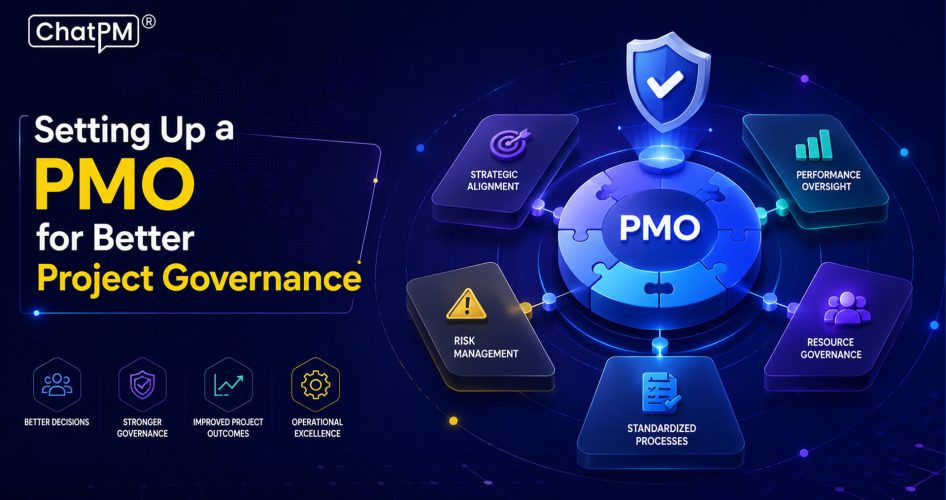
A Project Management Office is a centralized department that defines, maintains, and enforces project management standards across an organization. It connects company strategy to day-to-day execution, making sure projects stay on time, within budget, and tied to business goals. Successful PMO implementation starts with getting this foundation right.
From there, the PMO takes ownership of governance, resource allocation, reporting, and process standardization. It gives project managers a consistent framework to work within, helps leadership prioritize the right projects, and keeps performance data visible at every level. It is the operational backbone that turns project activity into measurable business output.
Types of PMO at a Glance
1. Supportive PMO: Guides teams with templates and best practices, no enforcement.
2. Controlling PMO: Provides support while requiring strict compliance with set standards.
3. Directive PMO: Takes full control and directly manages all project execution.
What does an AI-powered PMO look like?
Setting up a PMO today means building it with AI as a core function, not an add-on. Automated risk detection, real-time portfolio dashboards, and predictive analytics have replaced the manual reporting cycles that traditional PMOs still depend on.
Here are the core features that make establishing a PMO with AI a completely different game:
1. Predictive Risk & Analytics
Scans historical project data to catch budget and schedule risks early. PMO Development gets sharper when the system warns you before problems escalate.
2. Agentic Automation
AI agents handle status reports, timesheet checks, and routine change requests autonomously. Your team stops doing admin work and starts doing actual project work.
3. Intelligent Resource Management
Recommends the right task distribution based on past velocity and workload data. Skill gaps across the team get surfaced before they slow a project down.
4. Automated Governance
Flags compliance issues instantly and checks projects against corporate targets in real time. Nothing drifts out of alignment without the PMO catching it first.
5. Meeting & Content Summarization
Transcribes meetings, pulls out action items, and drafts status updates within minutes. Hours of administrative work get reduced to something the AI handles on its own.
Why PMO Fails Without AI?
1. Data Overload: Unstructured project data buries teams in noise, not insight.
2. Reactive Risk Management: Budget overruns get flagged after the damage is already done.
3. Poor Resource Allocation: Manual capacity balancing across large portfolios invites error and bias.
4. Too Much Admin Work: PMO staff chase updates instead of delivering strategic value.
5. Weak Strategic Alignment: Project execution drifts away from enterprise KPIs without automated tracking.
How Do You Set Up a PMO From Scratch?
Setting up a PMO from scratch sounds straightforward until you realize most teams skip the steps that actually make it stick. This section breaks down the exact sequence, with AI built into the process from the very first day.
Step 1: Build Your PMO Charter With AI
Every PMO Setup Guide starts in the same place, and that is a clear charter that defines why the PMO exists. Use tools like ChatGPT or Gemini to draft your mission, governance structure, and KPIs before you touch a single platform.
Step 2: Set Up Intake, Governance, and Frameworks
A solid PMO Framework needs a standardized way to request, review, and approve projects across the organization. Use AI to generate your intake forms, risk registers, RACI matrices, and WBS templates so your teams are never starting from a blank page.
Step 3: Choose and Implement Your AI Toolset
Project Management Office Setup only holds up when the tools your team uses every day have AI built into their core functions. Platforms like ChatPM, ClickUp, and monday.com each bring native AI features that reduce admin work and keep portfolio visibility high.
Step 4: Run a Controlled Pilot
Before rolling anything out company-wide, pick one or two high-visibility projects and run your AI workflows through a real test. Measure time saved, collect feedback from the pilot teams, and fix what does not work before you scale.
Step 5: Measure, Optimize, and Scale
Once the pilot proves out, track your KPIs consistently and let the data tell you where the PMO is adding value and where it is not. Scale what works, cut what does not, and keep refining the process as your portfolio grows.
How do you integrate AI into a PMO from day one?
The biggest mistake organizations make is treating AI as something to layer on after setting up a PMO is already done. By the time the structure is built without it, the resistance is real and the rework is expensive. The teams that get this right do not add AI after the fact; they design the entire operating model around it from day one.
1. Set Governance and AI Guidelines
A strong PMO launch strategy starts with clear AI usage rules. Define what data AI can access and where humans decide.
2. Build an AI Sandbox Before You Scale
Any PMO implementation roadmap needs a safe space to test AI. Run a pilot project before AI touches your live portfolios.
3. Automate the Low-Hanging Fruit First
Start with tasks that eat time but deliver little strategic value. Plug AI into your existing platforms to handle routine admin work.
4. Build AI Literacy Across the Team
AI only works when your team actually trusts and uses it. Run prompt engineering workshops and treat adoption as a people problem.
5. Review, Refine, and Institutionalize
Set a regular cadence to review what AI gets right. PMOs that sustain value treat AI integration as an ongoing practice.
Ready to Build a PMO That Actually Works in 2026?
Building a PMO in 2026 is not about adding more process, it is about building the right structure with the right intelligence behind it. Every step in this guide, from the charter to the pilot to the AI integration, is designed to help your PMO deliver real value from the start. Organizations that get this right do not just manage projects better, they make better decisions at every level of the business.
The teams pulling ahead are not waiting to figure out AI later, they are designing their PMO around it from day one. That means smarter risk detection, leaner admin cycles, and portfolio visibility that leadership actually trusts. ChatPM is built for exactly this, giving your PMO the AI backbone it needs to operate at the speed and scale that 2026 demands. Start with ChatPM and build a PMO your organization will not want to work without.