Key Takeaways
- 01
AI helps teams manage project costs with greater accuracy. As a result, teams can maintain better financial visibility. - 02
AI can identify potential schedule delays before they escalate. Therefore, teams have more time to take corrective action. - 03
Early risk detection enables faster and better project decisions. In addition, teams can respond to emerging issues more proactively. - 04
Project analytics provides clearer visibility into project performance. As a result, managers can better understand changes across the project. - 05
AI improves reporting, resource planning, and overall project control. Consequently, teams can manage complex projects with greater confidence.
Modern projects involve complex budgets, tight deadlines, changing resources, and growing risks. However, traditional project controls often depend on manual reporting and historical data, making it difficult to identify problems early. AI Project Controls help project teams monitor performance, identify patterns, and gain timely insights across cost, schedule, and risk management. As a result, teams can move from reactive monitoring toward more proactive project control.
Ready to streamline campaign planning, task management, and team collaboration? Schedule a demo with ChatPM Pro today and discover how AI-powered project management can help your marketing team work smarter, collaborate seamlessly, and deliver projects faster.
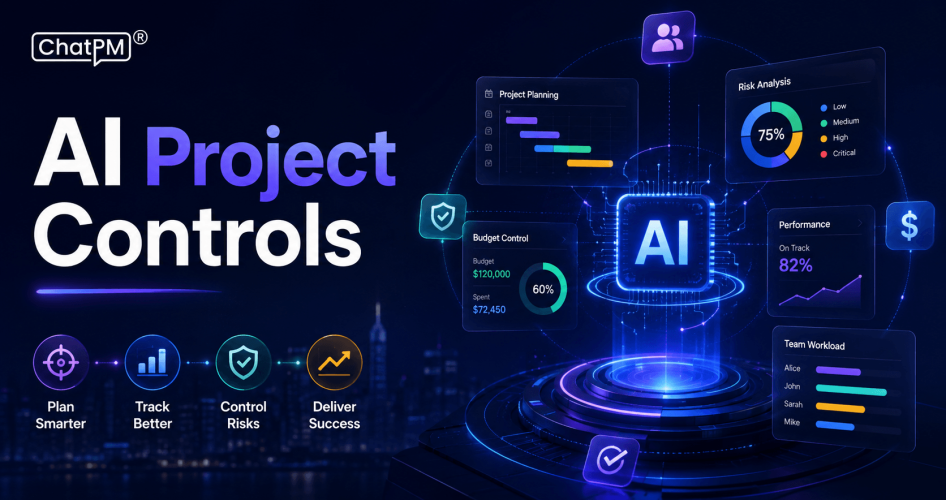
AI enables project teams to move from reactive monitoring to proactive decision-making. By analyzing project data continuously, AI can identify potential cost overruns, schedule delays, and emerging risks before they significantly affect project outcomes. Therefore, teams can respond to important changes earlier. In this blog, we will explore how AI is transforming modern project controls.
What are AI Project Controls?
AI Project Controls use artificial intelligence to help project teams monitor, analyze, and manage project performance. Instead of relying mainly on manual reports, teams can use AI to process large volumes of project data and identify important patterns. As a result, project managers gain clearer visibility into costs, schedules, resources, and potential issues.
Traditional project controls often tell teams what has already happened. In contrast, AI Project Controls can go further by identifying what could happen next. By analyzing current project conditions and past performance, AI can highlight unusual changes, predict possible problems, and support faster decisions. Consequently, project teams can stay ahead of issues instead of responding only after they occur.
Traditional Project Controls vs AI Project Controls
Traditional project controls rely heavily on manual tracking, periodic reports, and historical information. In comparison, AI-powered approaches bring faster analysis, continuous monitoring, and predictive insights to help project teams manage issues before they affect outcomes.
| Category | Traditional Project Controls | AI Project Controls |
| Data Analysis | Relies on manually collected and reviewed project data | Analyzes large volumes of project data automatically |
| Cost Management | Identifies budget issues through periodic reviews | Detects spending patterns and potential cost overruns early |
| Schedule Management | Tracks progress against planned timelines | Predicts possible delays based on project conditions |
| Risk Management | Risks are often identified through reviews and team assessments | Detects early warning signals and prioritizes potential risks |
| Decision Making | Decisions depend largely on reports and human interpretation | Provides timely insights to support faster, informed decisions |
| Project Monitoring | Monitoring is usually periodic and reactive | Enables continuous monitoring and proactive intervention |
Key Benefits of AI Project Controls for Enterprises
For large and complex projects, effective controls require consistent visibility across costs, timelines, resources, and risks. AI helps enterprises connect these areas and gives project teams better information for making timely decisions. As a result, teams can respond to changing project conditions more effectively.
1. Better Cost Visibility
Provides a clearer view of spending, budget performance, and potential financial issues. As a result, managers can identify important cost changes earlier.
2. Improved Schedule Control
Helps teams track progress, identify delays, and understand their potential impact on project delivery. Therefore, teams can review schedule concerns before they become larger problems.
3. Earlier Risk Detection
Identifies warning signs earlier, giving teams more time to assess and respond to potential problems. Consequently, project teams can take action before risks significantly affect delivery.
4. Faster Project Reporting
Reduces manual effort involved in collecting, analyzing, and preparing project performance information. In addition, this allows teams to spend more time acting on insights.
5. Better Resource Utilization
Helps managers understand resource requirements, workloads, and allocation across project activities. As a result, teams can identify resource gaps and allocation concerns more easily.
6. Data Driven Decisions
AI project controls turn complex project information into practical insights that support faster and more informed decisions. Therefore, managers can make decisions using a clearer view of current project conditions.
How AI is Transforming Project Cost Control?
AI project controls software helps project teams manage financial performance with greater visibility and accuracy. It can continuously analyze project data, identify unusual spending patterns, and highlight areas that may require attention. As a result, teams can address potential cost concerns earlier.
1. Real Time Cost Monitoring
Tracks project spending continuously and provides a clearer view of current budget performance. Therefore, managers can monitor financial changes more closely.
2. Early Cost Overrun Detection
Identifies unusual spending patterns and warns teams about potential budget problems before they become serious. As a result, teams have more time to review and control spending.
3. AI Based Cost Forecasting
Uses current project data and previous performance to estimate future costs and support better financial planning. Consequently, managers can make more informed decisions about expected project spending.
4. Budget Variance Analysis
Compares planned and actual spending to help project managers understand where financial performance is changing. In addition, this makes significant budget variations easier to identify.
5. Smarter Cost Decisions
Provides relevant insights that help teams take corrective action before small cost issues become major overruns. Therefore, teams can respond to financial concerns more proactively.
How AI Improves Schedule Control?
Project delays can affect budgets, resources, milestones, and overall project delivery. For this reason, Project Controls AI helps teams understand schedule performance continuously and identify potential delays before they create larger problems.
1. Predicting Schedule Delays
Analyzes project progress, dependencies, and historical patterns to identify activities that may fall behind. As a result, teams can review potential delays earlier.
2. Intelligent Resource Planning
Helps teams understand resource availability and workload so resources can be allocated more effectively. In addition, better allocation can help reduce potential schedule constraints.
3. Schedule Impact Analysis
Evaluates how changes in one activity may affect connected tasks, milestones, and the overall project timeline. Therefore, teams can understand the wider impact of schedule changes.
4. Progress Monitoring
Continuously compares actual progress with planned schedules to highlight important deviations. Consequently, managers can investigate schedule changes sooner.
5. Proactive Schedule Management
Gives project teams earlier visibility into potential problems, allowing them to take corrective action before deadlines are affected. As a result, teams can manage schedule risks more proactively.
AI for Smarter Project Risk Management
Project risks can emerge from changing requirements, resource constraints, supplier issues, delays, or unexpected cost changes. AI can help project teams identify these warning signs earlier and understand which risks need immediate attention. As a result, teams can prioritize their response based on current project conditions.
1. Identifying Emerging Risks
Analyzes project information to detect patterns and changes that could indicate potential problems. Therefore, teams can investigate emerging concerns before they become more significant.
2. Risk Prediction and Prioritization
Evaluates potential risks based on their likelihood and possible impact on project objectives. Consequently, managers can focus attention on risks that may require earlier action.
3. Automated Risk Monitoring
Continuously reviews project data to identify changes that could introduce new risks or increase existing ones. In addition, continuous monitoring provides a more current view of project risk.
4. Faster Risk Response
Provides timely insights that help project managers decide where corrective action is needed. As a result, teams can respond to important risk signals more quickly.
5. Connected Risk and Cost Visibility
Cost control AI can help teams understand how financial changes may contribute to wider project risks. Therefore, managers can consider cost and risk information together when making decisions.
The Role of AI in Project Analytics
Project analytics gives teams a clearer understanding of how a project is performing across different areas. AI strengthens this process by bringing together data from costs, schedules, resources, risks, and project activities. As a result, managers can see patterns that may be difficult to identify through manual analysis.
1. Real Time Project Insights
Analyzes current project information to provide a more up to date view of performance. Therefore, managers can work with more relevant project information.
2. Predictive Project Analysis
Uses existing data to identify possible changes in project performance before they become major concerns. As a result, teams can investigate potential changes earlier.
3. Performance Trend Identification
Finds recurring patterns across project data that can help teams understand where performance is improving or declining. In addition, this provides useful context for project decisions.
4. Connected Project Data
Brings information from different project areas together, reducing the need to review separate reports. Consequently, managers can access a more connected view of project performance.
5. Better Decision Support
Converts complex project information into useful insights that help managers make more informed decisions. Therefore, teams can respond to important project changes with greater clarity.
How Do AI Project Controls Work with Project Management Systems?
AI becomes more valuable when it works alongside the systems project teams already use. Instead of replacing existing tools, it can connect project information from different sources and provide a more complete view of project performance. As a result, teams can gain additional intelligence without changing their entire project management process.
1. Connects Project Data
Brings information from schedules, budgets, resources, documents, and project reports into one analytical environment. As a result, teams can review information from multiple project areas more efficiently.
2. Enhances Existing Systems
Adds intelligent analysis and predictive capabilities to existing project management platforms. Therefore, organizations can extend their existing systems with additional analytical capabilities.
3. Automates Reporting
Reduces manual reporting work by collecting project information and presenting relevant performance insights. In addition, this gives teams more time to focus on project management activities.
4. Improves Data Visibility
Helps project managers access important information without switching between multiple systems and reports. Consequently, teams can review project information more efficiently.
5. Supports Intelligent Workflows
Can identify important changes, trigger alerts, and help teams respond to project issues more efficiently. As a result, teams can take action sooner when project conditions change.
Ready to Make Project Controls Smarter With AI?
AI is changing how organizations manage project costs, schedules, and risks. By combining continuous monitoring, predictive insights, and intelligent analysis, project teams can identify issues earlier and make better decisions. As a result, this approach helps organizations improve visibility, reduce uncertainty, and manage complex projects with greater confidence.
ChatPM brings AI-driven intelligence into project management, helping teams connect project data, monitor performance, and gain actionable insights. In addition, its capabilities support cost, schedule, risk, and overall project visibility. As a result, ChatPM helps project leaders move toward more proactive and informed project control.
Frequently Asked Questions
1. How can AI improve project management?
AI analyzes project data continuously, helping teams identify cost issues, schedule delays, resource gaps, and risks earlier. As a result, project managers can make faster and more informed decisions.
2. What are AI Project Controls used for?
AI Project Controls help monitor costs, schedules, risks, resources, and overall project performance while providing predictive insights for proactive project management. Therefore, teams can maintain better visibility across critical project areas.
3. Can AI help prevent project cost overruns?
Yes, AI can analyze spending patterns, identify budget deviations, and highlight potential overruns early. Consequently, teams can take corrective action sooner.
4. Is AI useful for managing large projects?
AI is particularly useful for complex projects because it can process large amounts of information and provide teams with clearer, timely project insights. As a result, managers can review important project information more efficiently.
5. Can AI work with existing project management systems?
Yes, AI can integrate with existing project systems to analyze project data, automate reporting, improve visibility, and support smarter workflows. In addition, organizations can use these capabilities without necessarily replacing their current tools.