Key Takeaways
- 01
Project management KPIs measure project health by tracking schedule, budget, quality, productivity, and overall performance. - 02
Key performance indicators help project managers identify risks early and make data-driven decisions before issues escalate. - 03
Monitoring KPIs improves project forecasting, stakeholder reporting, and continuous performance improvement. - 04
Common project KPIs include schedule variance, cost variance, resource utilization, milestone completion, risk metrics, and customer satisfaction. - 05
AI-powered KPI dashboards provide real-time project insights that enable organizations to improve project outcomes and portfolio performance.
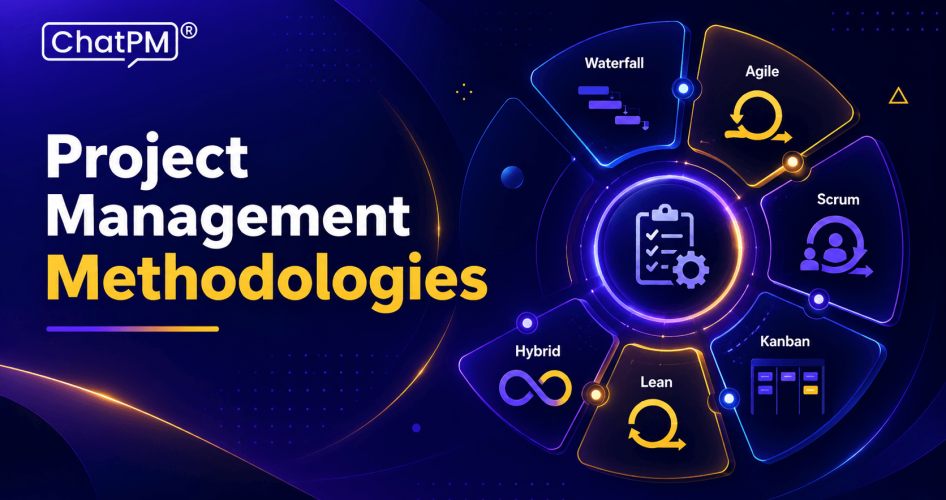
Project management methodologies provide structured approaches for planning, executing, and delivering projects. Popular methodologies include Agile, Waterfall, Scrum, Kanban, Lean, PRINCE2, and Hybrid. The right methodology depends on factors such as project complexity, flexibility, deadlines, team structure, and stakeholder requirements.
Modern project management analytics software helps teams monitor KPIs, visualize performance through KPI dashboards, and make data-driven decisions that improve project success. So, let’s dive in!
What is a Project Management Methodology?
A project management methodology is a structured approach that defines how a team plans, organizes, executes, monitors, and completes a project.
It can determine:
– How project requirements are collected
– How work is planned
– How tasks are prioritized
– How teams collaborate
– How progress is measured
– How changes are handled
– How risks are managed
– How deliverables are reviewed
– How the project is completed
Different methodologies solve different project management challenges.
For example:
1. Waterfall follows a sequential approach.
2. Agile focuses on adaptability and iterative delivery.
3. Scrum organizes Agile work into structured sprints and defined roles.
4. Kanban focuses on visualizing and continuously managing workflow.
5. Hybrid combines elements from multiple approaches.
It is also useful to understand that not everything called a “methodology” works at exactly the same level. Agile is better understood as a set of values and principles, while Scrum and Kanban provide more concrete ways of organizing work. Critical Path Method, meanwhile, is primarily a scheduling technique that can be used alongside a broader project approach.
Project Management Methodologies Comparison Table
| Methodology | Approach | Best For | Flexibility | Main Advantage |
|---|---|---|---|---|
| Waterfall | Sequential | Fixed-scope projects | Low | Predictable planning |
| Agile | Iterative | Changing requirements | High | Adaptability |
| Scrum | Sprint-based | Product/software teams | High | Structured iteration |
| Kanban | Continuous flow | Ongoing work | High | Workflow visibility |
| Lean | Waste reduction | Process improvement | Medium-High | Efficiency |
| PRINCE2 | Process-based | Structured projects | Medium | Governance |
| Critical Path Method | Schedule-based | Complex schedules | Medium | Deadline management |
| Six Sigma | Data-driven | Quality improvement | Medium | Defect reduction |
| XP | Engineering-focused Agile | Software development | High | Software quality |
| Hybrid | Combined | Complex organizations | High | Customization |
10 Popular Project Management Methodologies
1. Waterfall
Waterfall is a traditional project management methodology where work moves through predefined stages in sequence.
A typical Waterfall project may follow:
Requirements → Planning → Design → Development → Testing → Deployment
The next phase generally begins after the previous phase has been completed.
Best for:
– Construction
– Manufacturing
– Infrastructure
– Government projects
– Projects with stable requirements
– Projects with strict regulatory requirements
Advantages:
– Clear project phases
– Easy-to-follow timeline
– Defined deliverables
– Predictable documentation
– Straightforward progress tracking
Limitations:
– Changes can be expensive
– Customer feedback may arrive late
– Problems discovered late can affect the timeline
– Less suitable for uncertain requirements
2. Agile
Agile is an adaptive approach that emphasizes collaboration, iterative delivery, customer feedback, and responding to change.
Instead of planning every detail at the beginning, teams continuously review priorities and adjust their work.
Agile is commonly used in:
– Software development
– Product development
– Digital projects
– Startups
– Innovation projects
The main idea is to deliver useful work frequently instead of waiting until the entire project is complete.
3. Scrum
Scrum is a structured framework commonly used within Agile environments.
Work is divided into short periods called sprints, often lasting one to four weeks.
Typical Scrum elements include:
– Product Backlog
– Sprint Planning
– Sprint Backlog
– Daily Scrum
– Sprint Review
– Sprint Retrospective
Scrum works particularly well when teams need a predictable rhythm for planning, development, review, and improvement.
4. Kanban
Kanban uses a visual workflow to help teams understand what work is planned, in progress, and completed.
A basic Kanban board may contain:
To Do → In Progress → Review → Done
Teams can also establish work-in-progress limits to prevent too many tasks from being handled simultaneously.
Kanban is useful for:
– Support teams
– Marketing
– Content production
– Product teams
– Software maintenance
– Operations
Its major advantage is workflow visibility.
5. Lean
Lean project management focuses on delivering value while reducing unnecessary work, delays, waste, and inefficiencies.
Teams identify activities that do not contribute meaningful value and look for ways to eliminate or reduce them.
Lean can be useful when organizations want to:
– Improve efficiency
– Reduce unnecessary processes
– Shorten delivery time
– Improve resource utilization
– Increase customer value
6. PRINCE2
PRINCE2 is a structured project management approach that emphasizes defined processes, roles, responsibilities, business justification, and governance.
It can be particularly useful for organizations managing complex projects where accountability and documentation are important.
PRINCE2 is commonly associated with:
– Government projects
– Enterprise projects
– Large organizations
– Highly governed environments
7. Critical Path Method
The Critical Path Method (CPM) is a scheduling technique used to identify the sequence of tasks that determines the minimum project duration.
Tasks are mapped according to their dependencies.
If a task on the critical path is delayed, the overall project completion date may also be delayed unless corrective action is taken.
CPM is especially useful for:
– Construction
– Engineering
– Infrastructure
– Complex implementation projects
8. Six Sigma
Six Sigma is a data-driven approach focused on improving quality and reducing process variation and defects.
It is often associated with the DMAIC framework:
Define → Measure → Analyze → Improve → Control
Six Sigma can be valuable for organizations that need measurable process improvements and strong quality controls.
9. XP
Extreme Programming (XP) is an Agile software development approach that emphasizes engineering quality, frequent releases, customer feedback, and continuous improvement.
Common XP practices include:
– Pair programming
– Test-driven development
– Continuous integration
– Frequent releases
– Continuous feedback
XP is most suitable for software teams working in environments where requirements can change quickly.
10. Hybrid
Hybrid project management combines elements of different methodologies.
For example, an organization might use:
– Waterfall for overall project governance
– Agile for software development
– Scrum for product development
– Kanban for support activities
Hybrid approaches are becoming increasingly useful because many modern projects do not fit perfectly into one methodology.
Instead of forcing the entire organization to use one approach, teams can select practices based on project requirements.
Agile vs Waterfall vs Hybrid
| Factor | Agile | Waterfall | Hybrid |
|---|---|---|---|
| Requirements | Can change | Usually fixed | Partially flexible |
| Planning | Iterative | Detailed upfront | Combination |
| Delivery | Frequent | Usually final-stage | Depends on project |
| Customer feedback | Continuous | Usually later | Regular or phase-based |
| Change management | Easy | More difficult | Moderate-Easy |
| Best for | Uncertain projects | Predictable projects | Complex projects |
| Team collaboration | High | Moderate | High |
| Flexibility | High | Low | High |
Which One Should You Choose?
Choose Waterfall when requirements are clearly defined and major changes are unlikely.
Choose Agile when customer requirements, priorities, or product features are expected to change.
Choose Hybrid when different parts of the project require different management approaches.
The important point is that Agile is not automatically better than Waterfall. The right choice depends on the project environment.
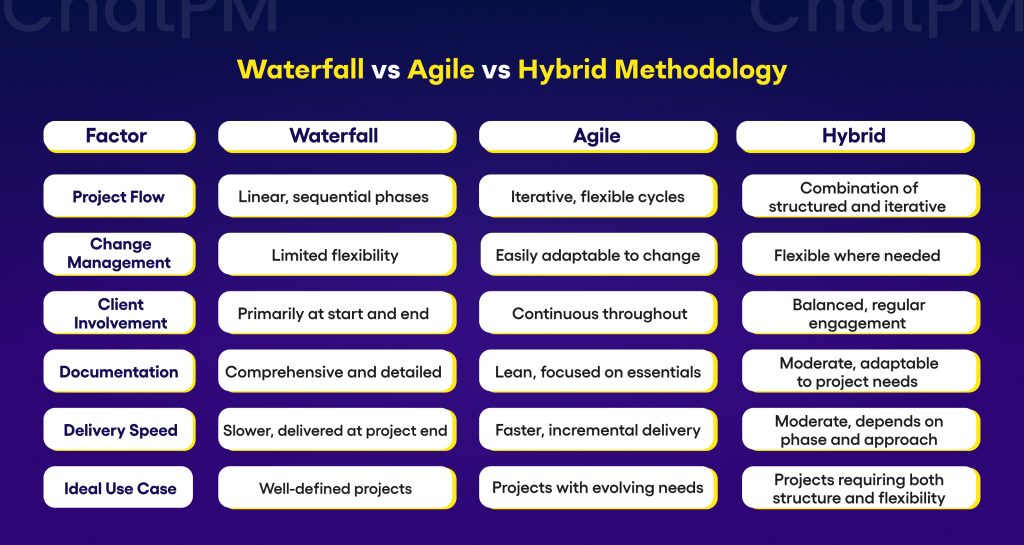
Must Read – Waterfall vs Agile vs Hybrid
How to Choose the Right Project Management Methodology
Choosing a methodology should start with the project – not the tool or trend.
Consider these factors:
1. Project Requirements
Are requirements fixed or likely to change?
Fixed requirements generally support Waterfall, while evolving requirements may favor Agile.
2. Project Complexity
Simple projects may not require a highly structured methodology.
Complex projects may benefit from additional governance, scheduling, documentation, or risk controls.
3. Timeline
If deadlines are strict, techniques such as Critical Path Method can help identify activities that directly affect the completion date.
4. Team Structure
Consider:
– Team size
– Team experience
– Communication style
– Geographic distribution
– Availability of stakeholders
5. Stakeholder Involvement
If customers or stakeholders need to provide frequent feedback, an iterative methodology may be more appropriate.
6. Risk and Uncertainty
Projects with high uncertainty often benefit from approaches that allow teams to test assumptions and adapt plans.
7. Industry Requirements
Some industries require detailed documentation, approvals, compliance processes, or formal governance.
8. Organizational Culture
A methodology should fit the organization’s ability to adopt new processes.
The best framework is one the team can consistently follow.
Project Management Methodology Decision Tree
Use this simple decision process:
Are requirements clearly defined?
→ Yes: Consider Waterfall or PRINCE2.
→ No: Consider Agile.
Does the team need short, structured development cycles?
→ Yes: Consider Scrum.
→ No: Continue evaluating.
Does the team manage continuous incoming work?
→ Yes: Consider Kanban.
→ No: Continue evaluating.
Does the project require strict schedule dependency management?
→ Yes: Use Critical Path Method alongside your primary methodology.
Does the project contain different types of work?
→ Yes: Consider Hybrid.
Does process quality and defect reduction dominate the project?
→ Yes: Consider Six Sigma or Lean.
This decision tree is not a strict rule. Many organizations combine techniques to create an approach that fits their specific needs.
Project Management Methodologies in 2026
Project management in 2026 is becoming more adaptive, data-driven, and AI-assisted.
Teams are increasingly expected to manage projects across distributed teams, multiple systems, changing priorities, and growing volumes of project information.
Several trends are particularly important:
1. Greater Use of Hybrid Approaches
Organizations are combining methodologies instead of following one framework rigidly.
2. AI-Assisted Project Planning
AI can help analyze project information, identify patterns, summarize discussions, and support planning.
3. Predictive Risk Management
Project teams can use historical and current project data to identify potential risks earlier.
4. Continuous Prioritization
Instead of reviewing priorities only during formal planning cycles, teams can continuously evaluate priorities based on project progress and business needs.
5. Human-in-the-Loop AI
AI is increasingly being positioned as decision support rather than a replacement for project leadership.
PMI’s 2026 AI standard emphasizes human oversight, governance, risk management, data quality, and accountability when applying AI to project work.
How AI Is Changing Project Management Methodologies
AI is not necessarily replacing traditional project management methodologies. Instead, it is changing how teams execute them.
For example, in a Waterfall project, AI can assist with:
– Requirements analysis
– Documentation
– Risk identification
– Status reporting
– Schedule analysis
In Agile environments, AI can support:
– Backlog analysis
– User story generation
– Sprint planning
– Meeting summaries
– Dependency identification
– Risk detection
In Kanban environments, AI can help identify:
– Workflow bottlenecks
– Tasks that are aging
– Workload imbalances
– Priority conflicts
Research published in 2026 identifies AI applications across project management including operational efficiency, decision-making, resource allocation, risk management, real-time monitoring, and administrative work.
However, AI-generated recommendations still require human judgment. PMI specifically emphasizes that AI can support decisions but cannot take accountability for them.
How AI Project Management Software Supports Different Methodologies
Modern AI project management software can provide a common workspace while allowing teams to work according to different methodologies.
1. Waterfall Teams
AI project management software can help with:
– Project schedules
– Milestones
– Dependencies
– Progress reporting
– Risk monitoring
2. Agile Teams
AI can support:
– Backlog prioritization
– Sprint planning
– Task breakdown
– Progress summaries
– Retrospective insights
3. Scrum Teams
– AI can assist with:
– Sprint planning
– User stories
– Task estimation
– Daily updates
– Sprint reporting
4. Kanban Teams
AI can help monitor:
– Work-in-progress
– Bottlenecks
– Task aging
– Workflow capacity
– Team workload
5. Hybrid Teams
Hybrid teams can combine:
– Gantt-style planning
– Agile boards
– Sprint workflows
– Milestones
– Dependencies
– AI-assisted reporting
This flexibility is important because organizations often manage multiple project types at the same time.
Why Teams Use ChatPM
Managing a project methodology is easier when planning, tasks, collaboration, and project information are connected in one environment.
ChatPM is designed to bring project management and AI capabilities together so teams can organize work while using AI to support everyday project activities.
Teams can use ChatPM to:
– Organize projects and tasks
– Track project progress
– Collaborate with team members
– Manage project information
– Support AI-assisted project workflows
– Improve visibility across projects
– Reduce repetitive project management work
Instead of treating AI as a separate chatbot, teams can integrate AI assistance into their broader project management workflow.
This can be especially useful for teams that want to combine structured project management with AI-assisted planning and decision support.
Best Practices for Implementing a Project Methodology
Choosing a methodology is only the beginning. Successful implementation requires consistent execution.
1. Start With the Project Goal
Clearly define what the project must achieve before selecting processes or tools.
2. Keep the Methodology Practical
Do not add unnecessary meetings, documentation, or processes.
The methodology should help the team—not slow it down.
3. Define Roles and Responsibilities
Every team member should understand:
– What they own
– What they need to deliver
– Who makes decisions
– Who approves work
4. Establish Clear Priorities
Teams should know which tasks have the highest business or customer value.
5. Track Progress Consistently
Use milestones, dashboards, task status, sprint progress, or other appropriate metrics.
6. Manage Dependencies
Identify tasks that depend on other tasks, teams, systems, or external stakeholders.
7. Review Risks Regularly
Don’t wait until a risk becomes an issue.
Review potential risks throughout the project lifecycle.
8. Use AI Responsibly
AI can accelerate project work, but teams should establish clear rules around:
– Data privacy
– Human review
– Accuracy
– Security
– Accountability
– Appropriate AI use
AI adoption should improve project outcomes rather than simply add another tool. Current project-management guidance emphasizes governance, training, integration with existing systems, and maintaining human judgment when implementing AI.
9. Measure Results
After completing a project, review:
– Was the project delivered on time?
– Was it within budget?
– Were requirements met?
– Were stakeholders satisfied?
– What caused delays?
– What should change next time?
Continuous improvement helps organizations refine their methodology over time.
Conclusion
Choosing the right project management methodology can make it easier to organize work, manage priorities, improve collaboration, and deliver projects successfully.
But methodology alone isn’t enough. Teams also need the right system to plan work, monitor progress, collaborate, and make informed decisions.
Ready to bring AI into your project management workflow?
Explore ChatPM and discover how AI-powered project management can help your team plan, organize, and manage projects more effectively.