Key Takeaways
- 01
Waterfall suits projects with fixed goals, clear structure, and predictable timelines. - 02
Agile delivers faster results through flexible sprints, continuous feedback, and team collaboration. - 03
Hybrid methodology combines Waterfall’s structure and Agile’s flexibility for balanced project control. - 04
Choosing the right methodology depends on project goals, team dynamics, and requirement stability. - 05
Each methodology has distinct strengths, and no single approach fits every project perfectly.
Have you ever questioned yourself about the best project management technique that fits your team? The debate around waterfall vs agile vs hybrid methodology has been ongoing for years, and each method brings its own strengths. Other teams would like the gradual process of Waterfall, whereas others would enjoy the flexibility of Agile. The next one is the hybrid model which combines both models to be more balanced.
The decision to use one of these approaches is usually based on the project objectives, team composition, and customer requirements. Waterfall provides some form of order, whereas Agile promotes flexibility and Hybrid is a combination of both. Knowing the way each of them works could assist you with more effective planning of the projects and easier deadlines. In this blog, we are going to make comparisons of these three approaches in order to make you decide which one suits your project best.
Want to see how ChatPM Pro streamlines project workflows and boosts team efficiency? Schedule a demo today and discover a solution tailored to your business needs.
Understanding Waterfall Project Management
The waterfall methodology is an orthodox project management framework in which the work moves in a linear manner in one stage to another. Every stage like planning, designing, developing, testing and deploying of a system should be fulfilled before proceeding to the next stage. In the broader waterfall vs agile vs hybrid discussion, it is best suited for projects with well-defined goals and fixed requirements.
The following are the advantages of waterfall methodology:
1. Clear Structure
The stepwise approach ensures that all the steps are organized, and that no job is overlooked or hurried.
2. Predictable Timelines
Tasks have a predetermined sequence, and, therefore, it is easy to have the teams estimate the deadlines and delivery dates.
3. Strong Documentation
Each stage is also highly documented and therefore, it is easy to monitor the progress and control quality.
4. Easy to Manage
Managers can track performance in clear way because milestones are established early in the project.
5. Reduced Overlaps
Having defined stages, there is little confusion or duplication of responsibilities among teams.
6. Ideal for Stable Requirements
Best in projects that have clear and fixed goals and the expectations have been established at the beginning.
Curious about how AI is changing the way teams manage projects today? Learn how AI project management tools can automate tasks and improve team productivity.
Understanding Agile Methodology
The agile approach emphasizes agility, teamwork and rapid development of usable software in brief development cycles known as sprints. It enables teams to embrace change, receive feedback and also keep on improving. In the waterfall vs agile vs hybrid debate, Agile is perfect for projects where requirements evolve during development.
The advantages of agile methodology are the following:
1. Flexibility in Changes
Teams are able to change priorities and features depending on client feedback and new knowledge.
2. Faster Delivery
Frequent and small releases will assist in providing the clients with the value earlier in the project.
3. Continuous Improvement
The team can improve the process by conducting regular reviews after every sprint.
4. Improved Collaboration
Agile supports teamwork by encouraging meetings and team discussions daily.
5. Higher Client Satisfaction
Frequent feedback also makes sure that the final product is similar to the expectations of the clients.
6. Risk Reduction
Feedback will be obtained early and the problems can be corrected before they become bigger.
Looking to understand how AI complements Agile methodologies in modern project environments? Discover how AI in Agile project management practices and improving decision-making.
Understanding Hybrid Project Management
The hybrid approach is based on the structure of the waterfall approach and the adaptability of the agile methodology. It enables teams to design projects in stages such as waterfall and employ Agile methods in the process. This combination facilitates stability and flexibility hence suitable in both predictable and changing projects.
The following are the advantages of hybrid methodology:
1. Balanced Approach
Integrates the structure of Waterfall and the flexibility of Agile to have a better control over the project.
2. Better Risk Management
It will prevent risks by planning ahead and adjusting during the project.
3. Improved Communication
The teams and the clients are kept in sync with regular updates and organized plans.
4. Higher Efficiency
Avoiding uncertainties in the planning process alongside flexible implementation enhances productivity.
5. Adaptable to Any Project
Applicable to projects that have fixed and changing requirements.
6. Enhanced Client Confidence:
Clients are comfortable knowing that the project has been planned effectively and has room to make adjustments.
The continued debate of waterfall vs agile vs hybrid methodology emphasizes that both methodologies have their distinct advantages. This project management methodologies comparison shows that the best choice depends on the nature of your project, your team’s workflow, and the level of flexibility you need.
Waterfall vs. Agile vs. Hybrid Project Management: A Comparison
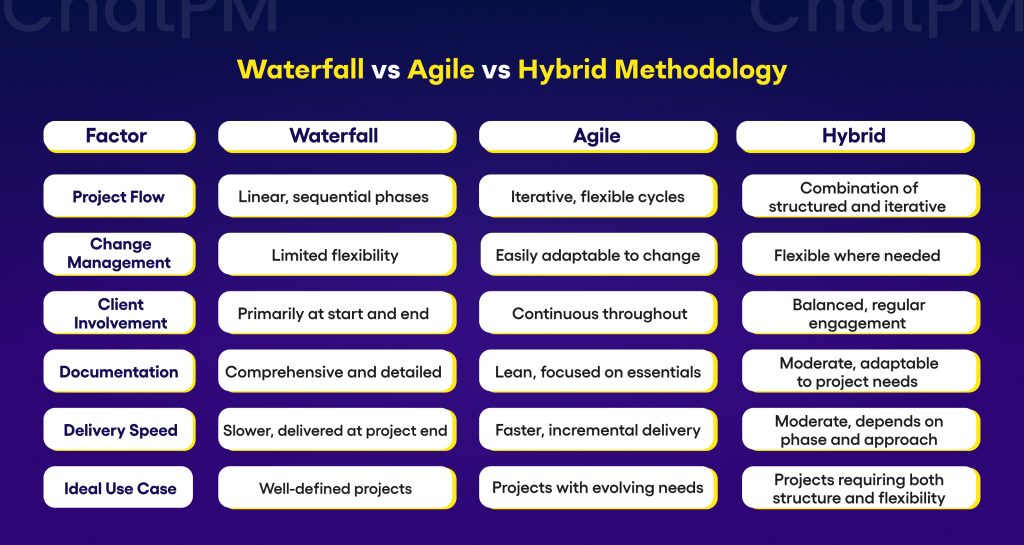
To better understand the differences between waterfall vs agile vs hybrid project management, it helps to compare their key characteristics side by side. The table below highlights important aspects to consider when deciding which project management methodology is best for your project needs and team workflow.
Which Project Management Approach Fits Your Team Best?
Choosing the right approach is easier when you understand waterfall vs agile vs hybrid project management. Every methodology possesses distinct advantages of structured planning, as well as flexible development. Being aware of their differences assists the teams with the selection of the appropriate approach and the performance of projects more effectively.
ChatPM assists teams with using these methodologies in a more coherent and controlled way. Having built-in insights, templates, and guidance, it helps plan and make better decisions, which can help project managers organize workflows, monitor progress, and achieve successful results with more confidence.