Key Takeaways
- 01
Agile thrives on iteration, not perfection or rigid planning. - 02
The right tool fits your workflow, not the other way around. - 03
Sprint visibility and real-time tracking directly impact delivery outcomes. - 04
Tool overload is a real risk; simplicity drives better adoption. - 05
AI-powered platforms like ChatPM are redefining how Agile scales.
Picking the right agile project management tools can be the difference between a sprint that ships on time and a backlog that never sees daylight. With velocity tracking, burndown charts, and cycle time metrics already baked into your team’s workflow, the real challenge in 2026 is no longer measuring performance. It is finding a tool that actually supports how your team moves.
But how do we create a real-time, end-to-end agile environment without drowning in a sea of integrations, feature bloat, and per-seat pricing that scales faster than your roadmap? If that question sounds familiar, we got you covered. In this blog, we break down the best agile project management tools of 2026 so you can cut through the noise and find the one that fits. So, let’s dive in!
Looking for one of the best agile planning tools for modern teams? Schedule a ChatPM demo to see AI-powered sprint planning and project automation in action.
Why Use Agile for Project Management? A Quick Dive In
Agile is an iterative project management approach that breaks complex projects into smaller, flexible cycles called sprints. Unlike traditional waterfall methods, it keeps teams focused on continuous delivery, real customer feedback, and course corrections that actually matter. The right agile project management software does not just digitize your workflow; it gives your team the structure to move fast without losing visibility.
So, let us look at the core reasons why teams use Agile for project management.
1. Accelerated Time-to-Market
Agile delivers working features in short, continuous cycles rather than one big release. This keeps your product moving forward and your team ahead of market shifts.
2. Unmatched Adaptability
Changing requirements mid-project no longer means starting from scratch. Agile is built to absorb scope changes at any stage without derailing the entire timeline.
3. Higher Quality and Reduced Risk
Breaking work into smaller cycles means teams test and validate at every step. Issues surface early, stay small, and never snowball into project-wide failures.
4. Better Predictability
Fixed-duration sprints make resource allocation, cost estimation, and performance tracking far more manageable. You always know where the project stands. This is exactly where the right Agile project management tools make a measurable difference.
5. Superior Customer Satisfaction
Clients and stakeholders stay involved throughout the project lifecycle, not just at kickoff. The result is a final product that actually reflects their needs.
6. Improved Team Communication
Agile is built on daily collaboration and consistent team interaction. Everyone stays aligned, dependencies get flagged early, and confusion rarely gets the chance to build up.
Best Agile Project Management Tools in 2026
With dozens of options on the market, choosing the right one comes down to flexibility, integrations, and how well it fits your team’s workflow. We tested and researched the most widely used platforms, so you do not have to. Here are the best project management tools built for Agile teams in 2026.
1. ChatPM
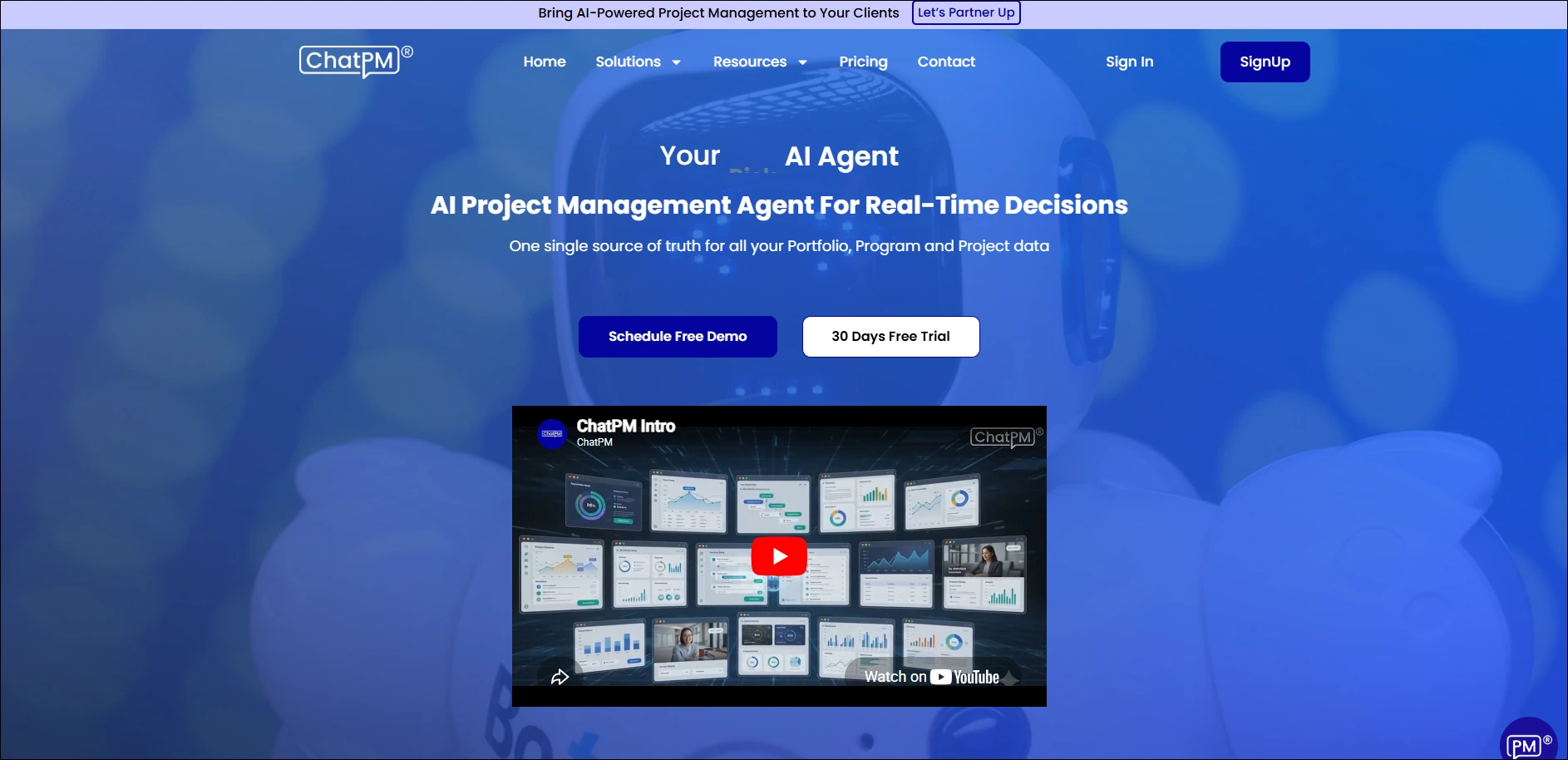
ChatPM is an AI project management tool that functions as a virtual assistant, automating status updates and simplifying complex data tracking across sprints and budgets. Its native integrations with Microsoft Azure, PowerBI, and Teams make it one of the most connected platforms available for Agile teams in 2026.
2. Wrike
Wrike delivers highly structured workflows with advanced reporting built right in. Real-time analytics keep cross-functional teams and client deliverables consistently on track.
3. Jira
Jira remains the gold standard for issue tracking, sprint planning, and backlog management. Its deep integration into developer toolchains makes it a non-negotiable for most engineering teams.
4. Zoho Sprints
Zoho Sprints comes with built-in Scrum ceremonies right out of the box. Scrum masters can track iterations and manage sprint cycles without any heavy configuration.
5. ClickUp
ClickUp packs sprint widgets, velocity charts, docs, time tracking, and smart automation into a single platform. It is also one of the most feature-rich agile project management tools free tier options currently on the market.
6. Asana
Asana connects individual task execution directly to Agile roadmaps and OKR frameworks. Its clean, intuitive interface keeps even large cross-functional teams moving without the learning curve.
7. Microsoft Azure DevOps
Azure DevOps creates a tightly integrated environment for scaling Agile across large developer groups. Source control, sprint planning, and pipeline management all live in one place.
8. Monday.com
Monday.com scales smoothly from small teams to enterprise operations with smart automations that help predict delays before they happen. It earns its reputation as a complete Work OS.
9. Trello
Trello mirrors the simplicity of analog sticky notes while remaining fully capable of scaling through power-ups. Its intentional simplicity makes onboarding effortless for any team size.
10. Linear
Linear is built for speed, with a keyboard-friendly interface and streamlined issue tracking that developers genuinely enjoy using. It cuts the noise and keeps engineering teams focused on shipping.
Best Agile Project Management Tools Comparison (2026)
| Tool | Best For | Key Agile Features | AI Features | Free Plan | Starting Price |
|---|---|---|---|---|---|
| ChatPM | AI-driven project management & enterprise teams | Sprint planning, backlog management, real-time dashboards, Azure & Power BI integration | ✅ AI assistant, automated status updates, predictive insights | Demo | Contact Sales |
| Jira | Software development teams | Scrum boards, Kanban, backlog, sprint reports, burndown charts | Limited AI | ✅ Yes | From ~$8/user/month |
| ClickUp | All-in-one project management | Sprint management, goals, docs, dashboards, automations | ✅ ClickUp AI (paid) | ✅ Yes | From ~$10/user/month |
| Asana | Cross-functional business teams | Timeline, Agile boards, workflow automation | ✅ AI features | ✅ Yes | From ~$11/user/month |
| Monday.com | Business operations & PMOs | Boards, sprint tracking, automations, dashboards | ✅ AI automations | Limited | From ~$9/user/month |
| Wrike | Enterprise collaboration | Custom workflows, Gantt, Agile boards, reporting | AI Work Intelligence | Limited | From ~$10/user/month |
| Zoho Sprints | Scrum teams & startups | Sprint planning, backlog, epics, velocity charts | ❌ No | Trial | From ~$2/user/month |
| Azure DevOps | Microsoft development teams | Boards, repos, pipelines, test plans | AI via Microsoft ecosystem | Limited | Pay-as-you-go |
| Trello | Small teams & beginners | Kanban boards, checklists, Power-Ups | AI (Atlassian Intelligence) | ✅ Yes | From ~$5/user/month |
| Linear | Modern software engineering teams | Issue tracking, sprint planning, roadmaps | AI issue creation | ✅ Yes | From ~$10/user/month |
Drawbacks of Using Agile PM Tools
1. Continuous adaptation often pushes timelines and budgets beyond initial estimates.
2. Detailed task tracking can quietly shift into a micromanagement culture.
3. Knowledge silos form when documentation takes a back seat to delivery.
4. Constant sprint cycles push developers and designers toward faster burnout.
5. Legacy system integrations and enterprise pricing frequently exceed planned budgets.
Ready to Take Your Agile Workflow to the Next Level?
Agile project management has moved well beyond sticky notes and whiteboards. The tools available in 2026 give teams real visibility into sprints, budgets, and delivery timelines without the guesswork. Choosing the right platform comes down to your team size, workflow complexity, and how well the tool integrates into your existing stack. The right fit will always outperform the most feature-heavy option on the market.
Not every tool, however, is built to think alongside your team. Managing real-time project data, automating status updates, and maintaining sprint accuracy simultaneously is where most platforms fall short. ChatPM bridges that gap by acting as an intelligent virtual assistant embedded directly into your workflow. If you are serious about scaling Agile without scaling complexity, ChatPM is where that journey starts.
Frequently Asked Questions
1. Is Agile only suitable for software development teams?
Not at all. Marketing, HR, and product teams have successfully adopted Agile frameworks to manage campaigns, hiring cycles, and roadmaps. It works for any team that values flexibility and iterative progress.
2. How long does it typically take a team to fully adopt Agile?
Most teams find their rhythm within two to three sprint cycles. The transition depends heavily on team size and how deeply waterfall habits are embedded. Proper onboarding makes a significant difference.
3. Can Agile and Waterfall methodologies be used together?
Yes, this is called a hybrid approach and many enterprises use it. Waterfall handles fixed, compliance-heavy phases while Agile manages the dynamic, iterative ones. It gives teams structure without sacrificing flexibility.
4. What is the ideal sprint length for most Agile teams?
Two weeks is the most widely used sprint duration across industries. It is short enough to stay focused and long enough to deliver meaningful output. Some teams run one-week sprints for faster feedback loops.
5. Do remote teams struggle more with Agile adoption?
Remote teams can run Agile just as effectively with the right communication habits in place. Async standups, shared sprint boards, and clear documentation replace the need for physical presence. Consistency matters more than location.