Key Takeaways
- 01
Traditional management excels in structure, predictability, and regulatory compliance. - 02
Agile prioritizes speed, collaboration, and continuous customer-driven delivery. - 03
Fixed scope projects benefit most from Waterfall’s rigid controls. - 04
Agile reduces late-stage risk through iterative sprint cycles. - 05
Choosing the right framework directly shapes your project outcomes.
Choosing between agile vs traditional project management is not just a methodology debate. It directly impacts your sprint velocity, resource utilization, and delivery timelines. The framework you commit to shapes how your team responds to scope changes, stakeholder expectations, and release cycles. As project complexity scales, your chosen methodology will define how every KPI performs under real pressure.
But how do we create a real-time decision framework without second-guessing every milestone? Don’t worry, we got you covered. In this blog, we break down the core structural differences, so your next framework decision is backed by clarity, data, and execution confidence. So, let’s dive in!
Understanding Traditional Project Management and How It Works
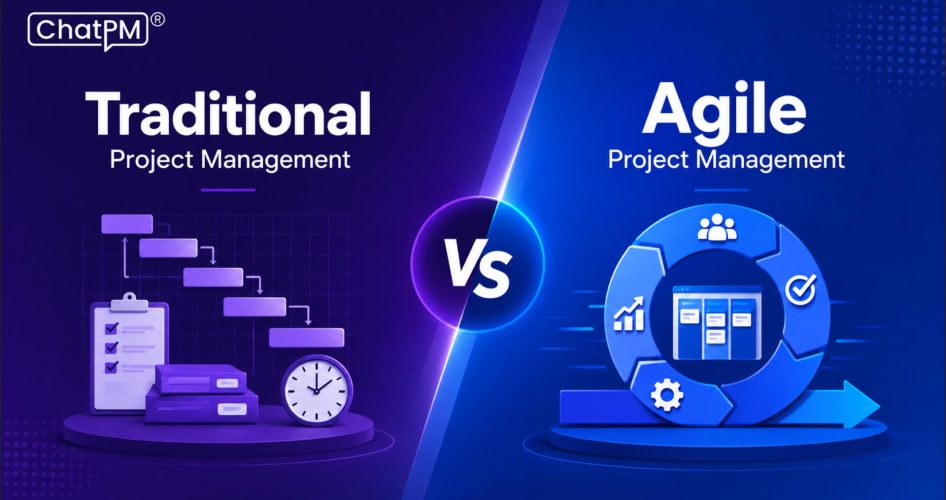
Traditional project management, often called the Waterfall method, follows a linear, sequential approach. Every project is heavily planned upfront before execution begins. Tasks flow step by step through initiation, planning, execution, monitoring, and closure. Each phase must be completed before the next one starts. This structure delivers highly predictable, fixed-scope outcomes with strict controls in place.
The traditional method relies on five core stages to drive delivery. First, objectives and feasibility are defined during initiation. Planning then maps out timelines, budgets, and risk strategies in full detail. Execution follows, where the team builds the actual deliverable. Monitoring enforces change controls to prevent scope creep. Finally, closure delivers the product and finalizes all administrative and financial sign-offs.
Key Advantages of Traditional Project Management
Traditional project management brings structure, clarity, and control to complex deliverables. When comparing agile vs traditional project management, the waterfall approach holds distinct advantages that still make it the preferred choice for many industries. Here are the key benefits that make it a reliable framework for structured project execution.
1. Defined Roles and Responsibilities
Every team member knows exactly what they are responsible for at each stage. This clarity reduces dependency conflicts and allows individuals to execute their tasks efficiently with minimal supervision.
2. Predictable Outcomes
Thorough upfront planning makes it significantly easier to forecast timelines, milestones, and final deliverables. Stakeholders get accurate projections from day one, reducing uncertainty across the entire project lifecycle.
3. Proactive Risk Management
The extensive planning phase gives project managers the space to identify potential threats early. Mitigation strategies are built in before execution begins, keeping the project insulated from avoidable disruptions.
4. Strict Scope and Budget Control
Detailed planning enables precise cost management and resource allocation from the start. Any changes require formal authorization, which significantly reduces scope creep and keeps delivery on track.
5. Comprehensive Documentation
Meticulous records are maintained at every stage of the project lifecycle. This simplifies handoffs, supports audit trails, and ensures full compliance with legal or regulatory requirements.
Drawbacks At a Glance
1. Rigid sequential phases make mid-project changes costly and complex.
2. Clients only review the final deliverable, risking misaligned expectations.
3. Critical bugs and flaws are caught too late in delivery.
4. Over-planning early stages drains resources before actual work begins.
5. Stakeholders receive zero usable value until full project completion.
Understanding Agile Project Management and How It Works
Agile project management is an iterative approach that breaks complex projects into shorter cycles called sprints. Each sprint typically runs between one and four weeks. Unlike traditional vs agile project management debates suggest, Agile prioritizes continuous feedback, team collaboration, and adaptability. Teams deliver working products faster while staying fully equipped to respond to shifting requirements.
Agile operates through a structured cycle driven by the Scrum framework. Teams maintain a product backlog, a prioritized list of all features and tasks. Sprint planning selects the highest priority items for each cycle. Daily stand-ups keep the team aligned and surface blockers early. At each sprint’s end, stakeholders review progress and teams run retrospectives to sharpen their workflow continuously.
Key Advantages of Agile Project Management
Agile project management delivers speed, flexibility, and continuous value across every stage of delivery. When comparing agile vs traditional project management, Agile consistently stands out for teams operating in fast-moving, feedback-driven environments. Here are the key advantages that make it a powerful framework for modern project execution.
1. Faster Time to Market
Agile delivers working product increments continuously rather than waiting for a single final release. This allows organizations to launch features earlier and gain a measurable competitive edge.
2. Greater Transparency
Daily stand-ups and sprint reviews give stakeholders consistent visibility into progress, performance, and blockers. Everyone stays informed and aligned throughout the entire project lifecycle.
3. Adaptability and Flexibility
Agile empowers teams to pivot quickly when business needs or customer preferences shift. Adjustments are incorporated in the next sprint without disrupting the broader project timeline.
4. Reduced Risk
Delivering in small increments allows teams to identify and resolve obstacles before they escalate. This approach virtually eliminates the risk of catastrophic project failure late in delivery.
5. Higher Customer Satisfaction
Customers remain actively involved throughout the entire development cycle, not just at the beginning. Continuous feedback integration ensures the final product aligns precisely with real-world needs and expectations.
6. Enhanced Product Quality
Integrated testing and iterative retrospectives are built into every sprint cycle. This ongoing focus on quality ensures the product improves consistently with each delivery increment.
Drawbacks At a Glance
1. Evolving requirements make accurate cost and deadline estimation nearly impossible.
2. Continuous flexibility often leads to uncontrolled scope creep over time.
3. Minimal documentation creates knowledge gaps during maintenance and team onboarding.
4. Constant collaboration demands heavy time commitment from all project stakeholders.
5. Scaling Agile across large, complex organizations requires significant coordination effort.
Traditional Project Management vs Agile Project Management: A Comparison Table
Every methodology carries its own strengths depending on project scope, team structure, and delivery expectations. Understanding the direct contrasts between agile vs traditional project management helps teams make faster, more confident framework decisions. Here are the core differences laid out side by side for complete clarity.
| Factor | Traditional (Waterfall) | Agile |
| Flexibility | Rigid, changes require formal approval | Adapts quickly to evolving requirements |
| Client Involvement | Limited to project start and end | Continuous collaboration throughout delivery |
| Delivery Speed | Single release at project completion | Working increments delivered every sprint |
| Risk Management | Risks identified only during planning | Monitored and resolved every sprint cycle |
| Product Quality | Testing happens at the very end | Integrated testing ensures consistent quality |
| Customer Satisfaction | Feedback received only after delivery | Real time feedback shapes every iteration |
| Team Collaboration | Hierarchical structure limits team input | Self-organizing teams drive better outcomes |
| Value Realization | ROI delayed until full project completion | Stakeholders gain usable value much earlier |
Which Project Management Framework Is Right for Your Team?
Choosing between agile vs traditional project management ultimately depends on your project scope, team structure, and delivery environment. Traditional methods deliver strong control and predictability for fixed scope projects. Agile brings speed, flexibility, and continuous value for dynamic teams. Understanding both frameworks equips project managers to make smarter, faster decisions that directly improve KPI performance and overall delivery outcomes.
Both methodologies have their place in a modern project management strategy. The key is knowing when to apply each framework without compromising timelines, budgets, or stakeholder expectations. Managing either approach demands the right tools, real time visibility, and intelligent tracking. That is exactly where ChatPM steps in. ChatPM is built for agile project management, giving teams the clarity, control, and sprint level insights needed to deliver consistently.
Frequently Asked Questions
1. Can a project use both Agile and Traditional methods at the same time?
Yes, this is called a Hybrid approach. Teams often use Waterfall for structured planning phases and Agile for execution and delivery. It works well when projects have both fixed regulatory requirements and flexible development needs.
2. Which methodology do large enterprises prefer and why?
Most large enterprises lean toward Traditional project management for compliance heavy or infrastructure projects. However, their product and tech divisions frequently run on Agile. The choice depends heavily on the department, risk tolerance, and delivery expectations.
3. Is Agile only suitable for software development teams?
Not at all. Agile has been successfully adopted across marketing, finance, healthcare, and product design teams. Any environment that demands quick iteration, continuous feedback, and adaptive planning can benefit from an Agile approach.
4. How does team experience level affect the choice of methodology?
Less experienced teams often perform better within Traditional frameworks due to clear structure and defined roles. Agile requires strong communication, self-discipline, and accountability. Experienced teams tend to thrive in Agile environments where autonomy drives performance.
5. What happens when Agile projects have strict regulatory compliance requirements?
Agile can still work in regulated industries, but requires additional documentation and governance layers. Teams often adapt their sprint processes to meet compliance checkpoints without sacrificing flexibility. It demands more planning but remains entirely achievable with the right structure.