Key Takeaways
- 01
Early risk identification helps minimize project delays and budget overruns. As a result, teams can respond to potential issues sooner. - 02
Clear communication reduces misunderstandings among stakeholders. In addition, it helps teams stay aligned throughout the project. - 03
Proper resource planning improves team productivity and workload balance. Therefore, teams can use available resources more effectively. - 04
Effective scope management prevents unnecessary project expansion and missed deadlines. Consequently, teams can maintain better control over project delivery. - 05
AI-powered project management tools simplify complex project execution. In addition, they can automate repetitive activities and improve project visibility.
Managing projects is challenging for any organization. Several projects may be active at the same time, with numerous tasks and different assignees involved. As a result, project managers can easily overlook important details while managing timelines, resources, and deliverables.
Project management is the backbone of successful business operations. However, managing discrepancies is not always easy. Project managers often deal with communication gaps, resource allocation issues, time management problems, and other challenges throughout the project lifecycle.
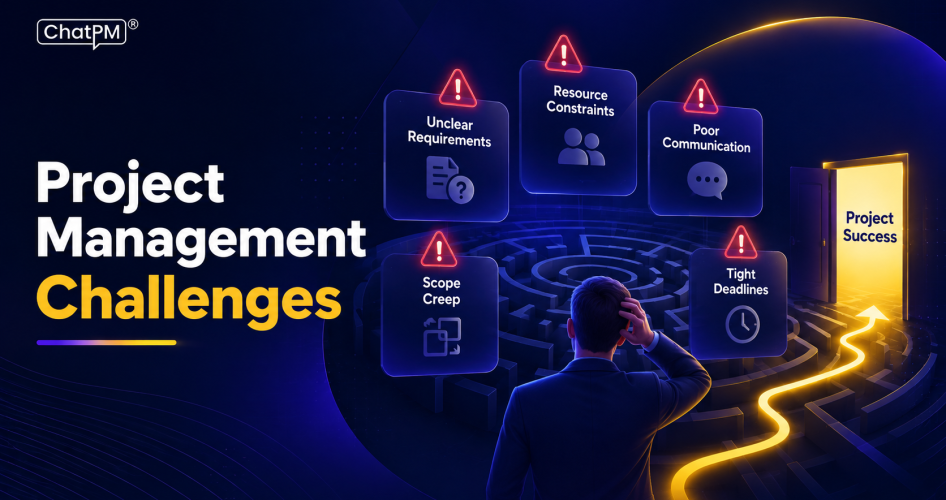
Some of these challenges can seriously affect project success. Therefore, understanding the most common issues and their solutions is important for project teams. In this blog, we cover five common project management challenges and explain how teams can overcome them.
How much time could your team save if these project management challenges were handled automatically? Schedule a demo with ChatPM to see how AI streamlines planning, collaboration, and execution so your team can deliver projects with greater speed and confidence.
What is Project Management?
Project management is the application of knowledge, skills, tools, and techniques to plan, execute, and monitor tasks and resources. It guides a team from project initiation to completion while keeping work aligned with defined scope, time, and budget requirements.
It includes activities such as defining project requirements, allocating resources, managing risks, and communicating with stakeholders. In addition, project management helps organizations turn ideas into practical outcomes, whether they are developing products, implementing organizational changes, or executing complex initiatives.
For example, consider a software development project for a new mobile application. The project may involve several stages, including need identification, planning, execution, monitoring, control, and launch. Each stage requires careful planning and resource management. Therefore, effective project management helps teams coordinate these activities and achieve the desired outcome.
5 Common Project Management Challenges
Communication Gap
Effective communication is fundamental to project success. However, communication gaps can slow progress and lead to misunderstandings. This challenge can arise for several reasons.
1. Lack of Clarity: Unclear project objectives, roles, and responsibilities can create confusion among team members. As a result, tasks may be delayed or completed incorrectly.
2. Poor Information Flow: Inadequate communication channels or ineffective tools can make it difficult to share information and project updates. Therefore, teams may not have access to important information when they need it.
3. Cultural and Language Differences: Global teams may face cultural differences and language barriers. Consequently, these differences can affect communication and collaboration if they are not managed effectively.
Scope Creep
Scope creep refers to the uncontrolled expansion of project requirements beyond the original scope. It can result in timeline delays, additional work, and budget overruns. Several factors can contribute to scope creep.
1. Changing Requirements: Stakeholders may request additional features or modifications during the project. As a result, the project scope can expand beyond the original plan.
2. Poor Scope Definition: Inadequate upfront planning and unclear scope definitions leave room for interpretation. Therefore, teams may find it difficult to control additional requirements.
3. Lack of Change Control: Without a formal change control process, unauthorized changes can enter the project. Consequently, these changes may affect timelines, resources, and budgets.
Resource Allocation & Budgeting
Efficient resource allocation within budget constraints is critical for project success. However, teams can face several challenges when managing resources and project finances.
1. Limited Resources: Scarce human, financial, or material resources can restrict project execution. Therefore, managers need to prioritize resources based on project requirements.
2. Overallocation or Underallocation: Improper resource allocation can lead to employee burnout or underutilization. As a result, project productivity and delivery can be affected.
3. Budget Constraints: Projects must operate within predefined budgets. Consequently, teams need accurate cost estimation and regular budget monitoring to avoid unexpected financial issues.
Risk Management
Projects involve uncertainty, making effective risk management essential for successful delivery. However, teams may struggle to identify and respond to risks early enough. Common risk management challenges include the following.
1. Identification of Risks: Failure to identify and assess potential risks can leave projects vulnerable to unexpected issues. Therefore, teams should regularly review project risks throughout the lifecycle.
2. Uncertainty: Projects operate in changing environments where external factors can affect outcomes. As a result, teams need flexible risk response strategies.
3. Lack of Mitigation Strategies: Inadequate planning for risk mitigation can increase the likelihood of project disruptions. In addition, proactive mitigation helps teams reduce the potential impact of identified risks.
Time Management & Optimization
Time management is essential for meeting project deadlines and delivering work on schedule. However, unclear priorities and inefficient workflows can make it difficult to manage project time effectively.
1. Unclear Priorities: A lack of clarity around task priorities and dependencies can make time management difficult. Therefore, teams should establish clear priorities before execution begins.
2. Inefficient Workflows: Bottlenecks and inefficient workflows can increase task durations and delay project completion. As a result, teams should regularly review workflows and remove unnecessary steps.
3. Scope Changes: Scope creep and uncontrolled changes can disrupt project schedules and timelines. Consequently, teams should evaluate the time impact of changes before approving them.
Role of ChatPM in Overcoming Project Management Challenges
1. Communication Gap
ChatPM provides a centralized communication platform that facilitates collaboration among team members. It also acts as an intelligent project management virtual assistant, allowing users to stay updated on ongoing project developments. In addition, its intuitive interface and multilingual support can help teams collaborate across different regions and languages.
2. Scope Creep
ChatPM helps project managers define and maintain a clear project scope through project planning and tracking features. Users can add Portfolios, Programs, Projects, Deliverables, and Sub-Deliverables using the ChatPM bot. As a result, teams can visualize project scope and monitor changes more effectively. The platform also allows project managers to review and approve scope changes, ensuring that additions and modifications remain within defined boundaries.
3. Resource Allocation & Budgeting
ChatPM provides resource management and budget tracking functionality, allowing project managers to allocate resources efficiently and monitor expenditures in real time. In addition, its cost module and budget tracking dashboards provide insights into resource availability and expenditure trends. As a result, managers can make proactive decisions and optimize resource utilization while staying within budget constraints.
4. Risk Management
ChatPM helps project managers manage project risks through its risk assessment and mitigation capabilities. It supports risk identification, assessment, and prioritization, helping teams anticipate potential threats. Furthermore, automated risk monitoring can evaluate risk triggers and alert project managers when action may be required. Consequently, teams can respond to risks before they have a larger impact on project outcomes.
5. Time Management & Optimization
ChatPM streamlines project workflows and supports time management through task scheduling, prioritization, and tracking capabilities. With customizable project reports made with Power BI, project managers can develop realistic timelines and allocate resources effectively. In addition, its built-in time tracking feature allows team members to record work hours accurately. This provides useful insights into task progress and helps identify bottlenecks that may require attention.
Conclusion
In summary, ChatPM provides a comprehensive project management solution for addressing common challenges faced by business teams. It supports communication, scope management, resource allocation, risk mitigation, and time optimization. As a result, teams can improve project visibility, manage potential issues, and work toward more efficient project delivery.
Frequently Asked Questions
1. What are the most common project management challenges?
The most common challenges include poor communication, scope creep, budget overruns, missed deadlines, resource constraints, and ineffective risk management. Therefore, identifying these issues early can help teams respond before they significantly affect project delivery.
2. How can AI help solve project management challenges?
AI can automate repetitive tasks, predict project risks, improve resource planning, provide real-time insights, and support better decision-making. In addition, AI-powered tools can reduce manual work and improve project visibility.
3. How do you prevent scope creep in projects?
Clearly define project requirements and establish a formal change management process. In addition, document stakeholder approvals and continuously monitor project progress. As a result, teams can identify unauthorized changes and manage scope more effectively.
4. Why do projects fail despite careful planning?
Projects can fail because of changing business priorities, poor communication, unrealistic timelines, limited stakeholder engagement, or ineffective risk management. However, regular monitoring and proactive issue management can help teams respond to these challenges.
5. What are the best strategies for improving project success rates?
Successful projects rely on clear objectives, regular communication, proactive risk management, collaborative tools, and continuous performance monitoring. Furthermore, using centralized project information can help teams make faster and more informed decisions.
6. Which industries benefit most from AI-powered project management?
Industries such as construction, IT, healthcare, manufacturing, consulting, and engineering can benefit from AI-driven project management solutions. In particular, organizations managing complex projects can use AI to improve planning, visibility, resource management, and decision-making.